What He brings you -
What you bring Him -
What a difference there is between them! (Hikam of Ibn Atallah)
Say, if you were selling something that was worth one dollar but someone came to you and offered you 70,000 dollars for it? Would it be a just transaction?
Say, you lived to be 80 years old and did nothing but pray and performed good deeds every single moment of your life. And for that someone wanted to reward you with thousands upon thousands upon thousands upon thousands thousands upon thousands upon thousands upon thousands upon… [Insert eternity here] of years worth of reward. Would it be a just transaction? (Attempting to paraphrase what i heard Shaykh Nuh say during an online class recording)
This really resonated with me today. Just the other day i was thinking about how lucky i am. Despite all my shortcomings, Allah's always blessed me. Why? Why is God so Compassionate toward Mankind? me? (im not complaining!)
It's like God creates situations just so He can bless me. Anytime someone’s looked down on me, God's blessed me; anytime ive suffered a loss, God's blessed me. Anytime ive made a booboo and felt bad over it, God's blessed me. Anytime, im lazy, He's created a conflict for me to resolve just so yup you guessed it -- So He can Bless me. I'm not being egotistical (ok maybe a little) but shouldn’t every human/spirit (whatever the heck we are) feel the same way? In essence, aren’t we all created in the highest of forms? (it's too bad we bring ourselves to the lowest of low) Entrusted with a trust even the mountains refused? gently guided with reminders? forgiven until the last breath?
When I look at what i have to offer...erm, it's sad. When i look at what He's Given me and Continues to Offer me, i feel embarrassed yet grateful. I love you God.
I wonder, if each subhaanallah will taste different now?
Ps. I never understood this hadith before but i think ive an inkling now. Like the Prophet (saw) who repented more than 70x a day, should we not be sincere and grateful?
Volume 8, Book 76, Number 474:
Narrated 'Aishan (raa): The Prophet (saw) said, "Do good deeds properly, sincerely and moderately, and receive good news because one's good deeds will not make him enter Paradise." They asked, "Even you, O Allah's Apostle?" He said, "Even I, unless and until Allah bestows His pardon and Mercy on me."
12/14/2005
Things that make you go, oh snap...

Kodak Moment...
There are certain realizations, certain insights that come to us momentarily but disappear into the fog of forgetfulness soon thereafter. I once heard a shaykh say something about pure souls being the only ones able to carry the knowledge of inward matters (or any useful knowledge for that matter). As a person who struggles daily with the most basic of self-disciplinary mechanisms I find writing what I know (momentarily) may benefit me in the future -- when I might not be aware of what I know right now. I don’t know where I will be in the coming months or years. I don’t know what kind of spiritual state I will find myself in. I don’t know how much of what I know now -- will I remember then, so it makes sense (for me) to capture thoughts and moments I find interesting. (Kind of like how Dumbledore extracts his memories and places them in whatever that fountain thingamajig is called).
Also, I have this eccentric desire to pass on all that I know (and have experienced) to my un-conceived progeny someday.
Perhaps, it’s my family’s fault. You see, whenever we get together we love to share tales from our childhood, our parent’s childhood, and our parent’s parents childhood! It’s as though we’re comparing notes, on life. And I still find it hilarious that my older khalas, my mother, my older cousins, and my generation have at some point tried stealing my grandfather’s cigarettes. (not because we were smokers but for the thrill, silly!) (really, we never inhaled!!). My grandfather, always knew (come on, who wouldn’t realize a broken seal on a brand new packet) but never said anything. I think, my generation takes the award for thickness though because we opted to go for cigars instead of cigarettes- since we saw my grandfather and his friends biting the tip (sadly we didn’t see them spitting it out)- and soon after found ourselves regurgitating the nastiest stuff ever digested by mankind.
But I digress. Another family trait that’s very popular. So yes, I write things because I don’t want to forget them. I want to preserve not just my insights into this thing called life but also my experiences – no matter how dumb they may sound. I would like my children to someday see the different stages of me and perhaps learn a thing or two from my experiences.
How cool would it be for a child, when he/she begins to catch his/her sense, to discover his/her parent’s journals? Wouldn’t it be cool for a young woman to see her mother as a young girl writing about the same issues she finds herself struggling with?
12/13/2005
Oh what a tangled web we weave...
 A collection of circles is said to be concentric if they have the same center. The circles on a bull's-eye target are concentric.
Concetric Circles found in American Southwest, Central Australia, Hindu Temples, Harappa - Pakistan, in Buddhist mandalaas, and many many more places ...leads one to wonder -- what is this human fixation with circles that have a Common Origin?
Apparently, we like them, as well!
====================================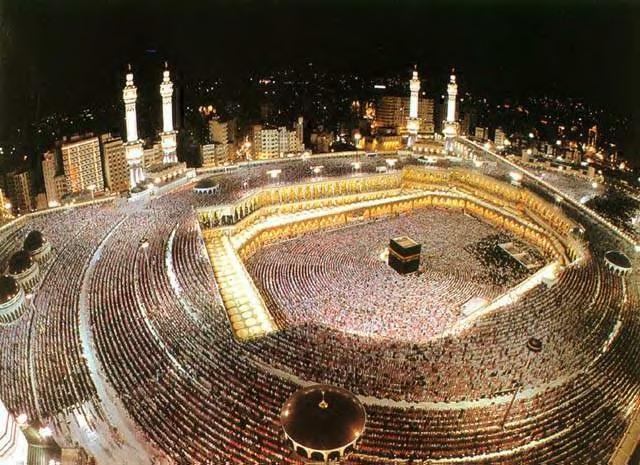
"Let us visit the historical cube in Mecca to conduct a thought-experiment: Imagine you are suspended in space in a satellite directly above the cube in Mecca. Presume also that it is night and all the lights in the world have been switched off. Now switch on the lights that shine on the courtyard of the Great Mosque of Mecca in which the cube is located and also switch on the lights of all the mosques of the world.
This is what you will see: directly below you will be the black square of the Kaaba at the centre of a vast concentric system of white circles that emanate from it like ripples. The innermost circles are in constant motion around it, and they are packed close together. White wheels within wheels unceasing in their motion. They are encircled by white circles that have a space between each other. These do not move around the cube but they do sway towards and away from it. Radiating away are unmoving white dots that make up bigger and bigger circles at greater distances from each other.
What are these three sets of ripples that emanate from the cube and what have they got to do with God asking Abraham to repair the cube?
The three sets of circles we saw while being suspended in space above the Kaaba were gatherings of people in different acts of worship (the word "ecclesiastical" which means "of the church" is from the Greek word ekklesia which means an assembly or gathering of people). Closest to the cube, the Kaaba, are the pilgrims dressed in the stipulated white unstitched garments, akin to their shrouds, circumambulating; walking seven times around the cube chanting to God, "Labaik, allahumma labaik" -"I am here, for You, I am here". They form the first set of moving concentric circles.
The next set of circles are pilgrims in concentric rows: standing, bowing and prostrating to God in the prescribed prayer. If the first set of circles move along the circumference then this set of circle moves along the radius, where each worshipper, while going from the standing, bowing and prostrating mode, is moving radially towards the centre of the cube and then receding. From your vantage viewpoint up in the night sky, this second set of circles would appear as white rings that pulsate: expanding in width and contracting. Finally, you have the distant circles that are made up of white dots that are the mosques of the world: segments of great circles (were you to light up all the graves of Muslims in the world, they too would lie in concentric ripples emanating from the Kaaba).
Thus, the mosque is defined as a segment of a circle whose centre is the Kaaba. For instance a mosque in New York would be a segment of the circle that passes through Canada, and crosses the Arctic to Russia, Mongolia, China, Vietnam, Singapore, and then crosses Antarctica, Peru, Colombia and Cuba, before re-entering the United States. The circle is made up by connecting the mosques, the white dots you saw from outer space that make the circle whose centre is the cube in Mecca.
This global concentric system made up by all the mosques in the world oriented to a single centre is a geometrical analogue of Tawhid - a doctrine of the Oneness of God and the unity of all existence. Tawhid is the foundation of Islam. Hence the cube is an ordering device; it is a marker that locates the centre of the concentric system. In it, all the axes of our horizontal plane of material existence converge and connect to the vertical axis mundi.
It is as an ordering device that the second, and less known, meaning of the word Kaaba comes into play. Kaaba, in Arabic, means the "cube" and also "a shape that emerges", i.e. both the form and the emergence of form. If the form is the cube, then what form remains to emerge?
As an ordering device, the Kaaba is not the modest cube in Mecca but a monumental project that has, for over a millennium now, been redefining the world in its own image. It has been constructing its circumferences (without which the centre is a point without identity). Each time a group of Muslims gather in prayer or build a mosque, each time Muslims follow the Prophet's practice of sleeping on the right side with their faces towards the Kaaba, each time a Muslim dies and is buried in a grave that is always oriented towards the Kaaba, in each instance a fragment of a circumference is being put into place. Prayer-halls, beds and graves are all rectangles with their larger side facing the Kaaba; all chords of its circumnavigating circles. With the global consolidation of a sacred centre, the faithful barely perceive that with their bricks and their bodies, they construct and constitute an international installation, the mother of all Monumental Art."
H. Masud Taj
12/10/2005
The Realty of Fantasy and the Fantasy of Realty
A sage lived to be couple of hundred years old. Yet, he never bothered to build a roof over his head. One day, his people asked him, how come he never built a roof for his house? He replied: “Well, I knew I was going to live for only 900 years (on earth), so why bother?”
(Can’t recall where I heard this)
12/06/2005
Sakeenah
I feel like a kid in a candy store...
Men and Women in Islam, For the Love of Our Children, Internal Nature of Shari'ah and its Eternality, Islam, Gender,and Spirituality... and so much more, now available on Sakeenah
Inaugral Welcome Message
12/05/2005
Overview of Muslims in America/American Islam
Covering Islam and Muslims in America Video - Professor Abdul HAkim Jackson
Linked From:
Agnibeena
Professor Sherman Jackson
Also, enjoy first 57 pages of Islam and the Blackamerican
12/02/2005
She Is a Ray of The Beauty of God
Water overpowers fire by (its) terror,
(yet) it boils when it is inside a partition.
(For) when a pot becomes the screen between
(these) two, it makes the water vanish (and) turns it (into) air.
If you dominate women outwardly, like water (over fire), you are
dominated inwardly and you are seeking [and boiling in desire for]
women.
This is such a special quality in mankind, (since) love is lacking
in animals, which is due to (their) deficiency.
The Prophet said, "Women become very dominant over wise and
pious (men),
"Yet ignorant (men) become dominant over women"-- because
they go (about) in a rash and very hot-tempered (manner).
They are lacking tenderness, kindness, and love because
animality dominates over (their) nature.
Love and tenderness are qualities of humanity, (while) anger and
lust are qualities of animality.
She is a ray of [the Beauty of] God; she is not a beloved.
She is a creator; you may say that she is not created.
Mathnawi I: 2429-37

12/01/2005
Is it worth it...?
I used to be angry. I was angry about all sorts of injustice in the world, mean people, unfair treatment, Dumb Principals -- Bush! i was so angry that i hardly did anything productive. i was so focused on the negatives in my life, that as a result, refused to do anything meaningful or positive. and then, I was given two excellent pieces of advice:
1. Our circumstances will never be perfect. An effective teacher/person is one who makes the best of her circumstances.
2. You’ve got to take that rage, that anger, and turn it into something positive.
and now i feel calm, unless im constipated, then ofcourse...ok nevermind. here's something interesting:
============================================================
"One thing most communities have in common now is that the people are in a state of agitation. One of the things that attracted me was the genuine sense of tranquility, calmness, and serenity in the masjids. People are starting to lose the virute of rida – tranquil serene acceptance of Allahs will. It’s alarming that Muslims should feel so disturbed or agitated by today’s world.
We complain about negative stereotypes but that’s always been the attitude toward the believers by the non-comprehending world. True religion is about akhira, it’s about transcending the self; it’s not about gratifying or discovering the self. We should be proud the modern world doesn’t like us because it’s a sign of authenticity. Nonetheless, it’s also the case when Muslims when they view this hostility don’t find solace in the traditional virtue of rida. We find agitation and insecurity and we increasingly judge, because any the slightest difference between ourselves makes us feel insecure, we want the religion to be a monolithic consistency that gratifies our sense of insecurity."
Excerpt from: Reliance on Allah
Prof. Hakim Murad
11/29/2005
Crazy - Talk
Sometimes I feel like a hero(ine). Not because I’ve done anything heroic but because I’m the central character of THE MOVIE. I’m a non- earthly spirit, an alien, (legal ofcourse), that’s been sent down to this world to fight many fights, to fall in love, to win many wars-- to deal with my subjects justly and fairly. I deal with all sorts of fellow spirits but mostly Zombies. Sometimes I’m a zombie myself but then I wake up during sleep. While sleeping, my sprit leaves this earthly body and goes on great adventures I don’t remember the next day. Maybe because my vertical connection is weak, I remind myself occasionally I need to take care of my connection, but five times a day seems like eternity sometimes.
Just like a car without an oil change my ‘self’ is covered with rust. Performance isn’t up to standard. That’s where Lord Shaitanmort comes into play. He distracts me with ME. He’s the salt-water that makes my ‘self’ rust even faster. But he’s just an extra. I’m the real deal – the real McCoy! Only I hold the power to be the ultimate Hero(ine) or Villain.
Occasionally, though, I do report back to the Compassionate Source and occasionally I do talk to the Beings of Light that stand by me, even though I suck. Why yes, I’ve got Beings of Light protecting me, watching over me, whispering to me. Unlike Beings of Flesh they constantly pray for me, weird aint it? Actually, whats weird is that im in a middle of a science fiction movie and I have a go at the 'Oscar' but instead I choose to be a D list actress. Actually, it’s sad, especially since my mama always said I was a drama-queen.
11/27/2005
Ali ra...
"The sin which makes you sad and repentant is more liked by Allah (swt) than the good deed which turns you arrogant."
11/25/2005
Pedagogy of the Oppressed
“Like Paulo, become a threat, become a threat to the system!” exclaimed a very excited NYU Professor couple of years ago. (No, he wasn’t talking to Muslims; he was simply addressing a group of student-teachers).
Imagine the teaching power of a person who is banned and exiled from a country for teaching. Yup, that’s it. And no he wasn’t teaching his students how to make bombs, either. He was simply banned for his Educational Philosophies. Now that’s power.
Paulo Friere, was banned from Brazil and lived in exile for most of his life. One wonders, why and how he was able to cause so much fear among authoritarian governments?

“In Brazil, peasants who participated in the cultural circles not only acquired tools to unveil structures of domination, but also acquired literacy skills in a record time of 40 days. Thus, the reason that led to the cancellation of the literacy project and to Freire's imprisonment was clearly not its inefficiency, but the military government's fear of its potential political implications. Upon being expelled from Brazil, Freire found political asylum in Bolivia, but after three weeks another coup d'etat forced him to seek refuge in an effervescent Chile, where a few years later he would witness yet another military intervention and a new exile. These experiences played an important role in his political radicalization.”
==============================================================
Excerpts taken from different sources but mostly from here:
1. In 'Pedagogy of the Oppressed,' Freire examines the authoritarian educational system, and labels its practice as 'banking education.' In this model, the teacher is the subject of the learning process, and the learners are its objects; the role of the teacher is to deposit contents in the mind of the learner, as if it was a tabula rasa to be filled with information. Hence, the teacher is considered as knowledgeable and the student as ignorant. This oppressive model, says Freire, mirrors the attitudes and practices of an oppressive society in which to be is merely to have. He also deplores the dogmatic approach of authoritarian revolutionary leaders who do not want to waste time in dialogue, thinking that such time could be better used to 'reveal the truth.' For Freire, this 'vanguardist' approach is as banking and reprehensible as the education model carried out by the elites.
2. Education either functions as an instrument which is used to facilitate integration of the younger generation into the logic of the present system and bring about conformity or it becomes the practice of freedom, the means by which men and women deal critically and creatively with reality and discover how to participate in the transformation of their world.
3. Paulo Freire recognized through this experience that learning which affirms the dignity of people can enable even poor men and women to become producers of culture, ready to overcome the culture of silence. The central objective of this method was to create a new level of awareness, to bring about a new consciousness among the people.
4. In opposition to the banking model, Freire proposes a liberatory or emancipatory one, based on a horizontal relation between teachers and learners (co-intentionality), on critical thinking and on social transformation. In Freire's model, the teacher becomes a facilitator, the traditional class becomes a cultural circle, the emphasis shifts form lecture to problem-posing strategies, and the content, previously removed from the learners' experience, becomes relevant to the group. For Freire, literacy implies as much the acquisition of language as a political process of citizenship, in which people take history into their hands. Hence, the departure point of any educational process is not the world of the teacher, but the world of the learner. He also suggested that a critical analysis of reality could start with a critical reading of the official curriculum. He pointed out that teachers and students alike tend to consider the curriculum as something given, a neutral content to be transmitted, without understanding that education is a political act. The more teachers and students challenge this naive perspective, the easier it becomes to engage in a critical analysis of social reality.
[to be cont'...]
11/18/2005
On Muslim Schools...
I’m surprised by the papers and articles I’ve browsed in the past few hours on Islamic Schools/Education in North America. Most authors believe that sending your child to a building labeled “Islamic School” will somehow transform him into the ideal muslim/muslimah, while sending your child to a public school will transform him into the illegitimate child of Britney Spears. Gulp?
Perhaps, I wouldn’t have ‘gulped’ if the following view was that of an uncle mullah or an auntie from back home but these views were of converts – Americans who’ve converted to Islam.
I went to a public school yet never tried drugs, wore small skirts, or had a bevy of boyfriends. I knew it was not part of the package to date before marriage even before I graduated kindergarten thanks to a very concerned mother. I don’t know why I didn’t try drugs, maybe because most students in my school weren’t selling drugs, or maybe because I was afraid my mother would whoop my arse (yes, we’re immigrants).
I’ve attended secular institutions all my life yet have always held a firm belief in God.
My learning of Islam began informally at an early age, at home. I grew up watching parents/grandparents reading salah, fasting, celebrating Ramadan and Eid. I learned maths and science in the morning and learned to read the quran in the afternoons. Solving mathematical problems or learning the Arabic language didn’t change my personality. Rather the change was the result of personal observation of models/stimuli around me.
I learned respecting elders was a virtue not from reading the Quran in Arabic but watching the way my mother treated her elders. I learned to love my elders not by reading salah in Arabic but by watching the lips of my grandfather which constantly moved sending durood on the Prophet (peace be upon him). My cousins and I used to try to outdo each other to bring water to one of my grandmothers sisters because she gave the best duas. Sometimes she would have to drink 5 glasses of water because we all wanted bonus points with Allah.
Having worked with two different Muslim Schools, I find it weird that the setting was only concerned with content but not how we learn to learn. Adding a Quranic Language and Islamic history course to a secular curriculum is somehow magically supposed to create an ideal muslim/muslimah? In most Muslim countries the practice of Islam is taught informally, outside of regular schools, not through formal settings like Islamic Schools or Sunday schools.
Learning is not something that takes place only in a classroom setting. In actuality, most of the learning takes place outside of the “classroom.” Even within the constructs of the classroom students not just observe the content but how the content is presented.
One could argue that learning how to learn is more important than the content itself.
Take Student X, a very bright child, placed in Hifz School XYZ at an early age. He can’t help peeking out of the door when ‘regular’ school-age students pass by during lunch break. He tells me he got hit by a hanger for doing it and is trying to learn his lesson so he can have his gaming rights back again from his parents. I wonder how much he’d love his religion when he grows up? (caution: example should not to be used to form ignorant generalizations about muslim schools in general.)
Meanwhile, theres student Y, an equally bright child, who is encouraged from an early age to question and explore, whose teachers treats him with unconditional respect, and whose parents lead a life that serves as a semi-good example for him. I wonder how different his perspective on life would be compared to student X?
I’m sure as new converts/reverts, lacking the moral support that comes with a practicing Muslim family unit, we strive to the best of our intentions and abilities to create an environment whose aim is to foster good moral values (Islamic values) and a desirability for God. But the creation of such environment isn’t found within cement or a concrete block with Arabic calligraphy; it is a process which begins with the birth of your child and ends with your last breath. If the child has the right support and role models from an early age, even a public/secular institution won’t lure him into sex and drugs. Similarly, abandoning your child to a poorly run Islamic school or once a week Sunday school won’t turn him into a Muslim scholar.
In conclusion, im not advocating one mode of schooling over another (heck, im thinking of home schooling, and I don’t even have kids, hah!), im just saying there are better arguments for creating Muslim schools than suggesting your kids will turn into cross-eyed-drugged out- sex offenders if you sent them to a public school. Really.

11/16/2005
Excerpts from Gifts From The Sea
"...I want first of all – in fact, as an end to these other desires – to be at peace with myself. I want a singleness of eye, a purity of intention, a central core to my life that will enable me to carry out these obligations and activities as well as I can. I want, in fact – to borrow from the languages of the saints – to live "in grace" as much of the time as possible."
===============================
“... Because we cannot deal with the many as individuals, we sometimes try to simplify the many into an abstraction called the mass. Because we cannot deal with the complexity of the present, we often over-ride it and live in a simplified dream of the future. Because we cannot solve our own problems right here at home, we talk about problems out there in the world...
But can one really feel deeply for an abstraction called the mass? Can one make the future a substitute for the present? And what guarantee have we that the future will be any better if we neglect the present? Can one solve world problems when one is unable to solve one’s own? Where have we arrived in this process? Have we been successful, working at the periphery of the circle and not at the center?
If we stop to think about it, are not the real casualties in modern life just these centers I have been discussing; the here, the now, the individual and his[/her] relationships? The present is passed over in the race for the future; the here is neglected in favor of the there; and the individual is dwarfed by the enormity of the mass...”
====================================================
"Life is a gift, given in trust - like a child."
=====================================================
"The most exhausting thing in life is being insincere."
=====================================================
Anne Morrow Lindbergh

10/31/2005
Tranquility is attractive...
I don’t consider myself a religious groupie but I do find myself gravitating towards certain scholars, ideologies, and books. In order to better understand why I like listening to certain people over others I made the following observations:
1. I like soft, peaceful, and calming voices. I don’t enjoy screaming marathons nor am I moved much spiritually by a person who thinks the louder they scream (even if in Arabic) the better I’ll grasp the concept in question. Interestingly, I don’t have a soothing pitch myself, in fact, in moments of excitement im reminded by loved ones to control my volume. Does the pitch of our tone give an inkling of how we feel inside? Do I find calm voices soothing because I lack calmness within myself? Incidentally, I was listening to Mr. Winters (Abdul Hakim Murad) and I kid you not a bird started chirping in the background, as if it was enjoying listening to him. He’s one guy who has a serene and soothing voice. More power to him.
2. I like people who aren’t frustrated easily, who control their anger, and sort of have this aura about them that exudes contentment. You can say anything to them, yet they’ll smile, nod, and make you feel like you have every reason to be unreasonably whiny, and yet still find a way to gently push you into a positive direction. I don’t enjoy angry, argumentative, academics because they bring nothing but a feeling of frustration. There’s no feeling of excitement only boredom. There are some very learned experts out there but not all of them have the ability to impart the ‘energy-force,’ that makes us want to be better people.
10/27/2005
Transformation
"His wisdom was only in his head, it never penetrated his substance. A man might spend a lifetime reading spiritual book sand studying the writings of the great mystics. He may feel he'd penetrated the secrets of the heaven and earth, but unless his knowledge was incorporated into his very nature and transformed him, it was sterile" - Gai Eaton
10/21/2005
Faith and Belief
64:11 No Kind of clamity can occur, except by the leave of God: and if anyone believes in God, (God) guides his heart (aright): for God knows all things.
Truly amazing is the affair of the believer. His affair only contains good. That realization only occurs for the believer. If he is blessed with good he thanks God and in that there is good. And if he is afflicted with difficulty he patiently endures and in that there is good.
Sahih Muslim #7425
So much for Satan, eh?
interesting review and description of the words, Faith and Belief.
==================================================================
"The word "belief" does not mean what it once meant, indeed it means something quite different. We still regard it as interchangeable with the word "faith" and equate it with religious conviction which, in its turn, relates to "certainty", at least on the subjective level. In modern usage, however, it implies uncertainty."
[...]
"In origin the word "belief" relates to love and commitment to the beloved rather than to the notion of holding certain particular opinions, as we can see from the dictionary definition of the word "lief" (which has only recently fallen out of use): "dear", "precious", "desired". It derives from the Old English leof or liof with which there was a cognate and more or less parallel form, lufu, meaning "affection" and suggesting passionate longing. ... The word "belief" has come to mean "the holding of certain ideas", ...
[...]
"He makes the important point that the Latin word which stands at the very centre of the Christian faith -Credo ("I believe") - indicates, not a hypothesis which some may accept and others reject, but the acknowledgement of a fact, it is virtually equivalent to the statement, "I see that ..." Credo indicates allegiance to a perceived truth."
[...]
"In its original meaning, then, "belief" is an act rather than a subjective state of mind but, in relation to modern usage, it seems reasonable to ask whether the distinction the author makes between "belief" and "faith" is valid. The blight of subjectivism has affected all the terms employed in religious discourse. Faith, belief, thought have all been cut loose from the notion of ascertainable objective truth; they have been reduced to a matter of current intellectual fashions and personal feelings. "I believe in God" has come perilously close to meaning, I feel there must be a God but, of course, I don't know"."
"The Muslim however might say that faith is an acknowledgement of the truth, belief adherence to the truth, and thought validated only in so far as it reflects the truth."
"Believing", says the author, has come to mean that "an opinion is held about which the person who holds it.... leaves theoretically unresolved the question of its objective intellectual validity". Such a notion is, he points out, entirely foreign to the Muslim's perception of the Qur'an, and he adds that the idea that religious people are expected to "believe" this or that is "a modern aberration". The very notion of "belief" as it is now understood is, he says, entirely absent from the Qur'an, whereas words for knowing are 'frequent and emphatic". A mu'min is not a "believer", but someone who makes an act of faith, and faith "is something that people do more than something that people have". His definition of kufr is certainly to the point; it is not - he says - "unbelief" but, rather, "refusal", even "a spitting in Allah's face when He speaks out of His infinite authority and vast compassion... It is man's negative response to this spectacular divine initiative". When the Muslim makes the Shahada, he is not making an affirmation of belief. He is bearing witness, "corroborating an observable objective fact". The response of the "Yes-sayer" to the truth is not "belief" but "recognition".
[...]
Excerpts taken from: Book Review: Faith And Belief
by Hasan Gai Eaton

10/19/2005
Random Babble
I love love love looking at the sky. Couple of years back, I was discussing some student with the assistant principal, who happens to be an established writer. as i was walking away he asked me to look up. i did. he then said, "The sky is so much bigger than you and me."
i thought that was a bit weird at the moment (because it had nothing to do with our discussion) and i called him on it (because i thought he was telling me i was arrogant), (which he wasnt!), (he said so!), in any case, from that forward i cant help but think about his simple statement, everytime i look up at the sky.
The Universe indeed is so much bigger than you and me.
============================================================
Heard this today: why do we call it the 'mad cow disease' when in actuality it is the 'mad cowboy disease?' Cows are herbivores, then why in the world are they being fed dead animals. further, i was told that the local muslim butcher buys sick animals because theyre cheaper! what the??
i will never look at biryani the same way again. what do i do? how do i know im not eating an omnivore (which are like kind of erm forbidden)? worse how do i know im not eating the entrails of some poor sick animal whose been fed his dead mommy because her dead bodys cheaper than cow feed. barf.
do i raise my own cow? right. i think ill just have to eat more veggies and fish. fish is safe? yey.
============================================================
Whatever we perceive in the world around us tends to reflect who we are and what we care about most deeply, as in the old saying, "When a thief sees a saint, all he sees are his pockets."Ragip Robert Frager
============================================================
You can burn books but you cant burn imagination
The broken bond between heaven and earth can only mend by a prayer from a broken heart.
Your teeth hold your words, your brain remembers them.
(Have to look up her name)
=============================================================
Lead such a life, that, when you die, the people may mourn you, and while you are alive they long for your company.
He who trusts the world, the world betrays him
Ali (Ra)
=============================================================

10/18/2005
Mind-Candy
Havent read most of them yet. thought someone else may benefit... so there.
Reading List : Education for Muslim and Teachers
Modern Science and the Eclipse of Tawhid - by William C. Chittick
Meetings with Imaginal Men
by William C. Chittick
www.ibnarabisociety.org/articles/divinerootsoflove.html
alchemy of happiness
Seyyed Hossein Nasr. Science and Civilization in Islam.
The Interior Life in Islam
The Qur'an and Hadith
as source and inspiration of Islamic philosophy
www.shariahprogram.ca/articles/
www.famsy.com/salam/page4.html

10/16/2005
Does the universe appear to follow mathematical laws?
The Greek mathematician Pythagoras declared that numbers were the basic elements of the universe. Ever since, most scientists have embraced a kind of mathematical creationism though some contend that mathematics is not an ethereal essence but comes from people who invented, not discovered it.
"Albert Einstein, taking a different view of whole numbers, wrote that "the series of integers is obviously an invention of the human mind, a self-created tool which simplifies the ordering of certain sensory experiences."
Even if the human mind is born with an innate-wired –in-aptitude for mathematics that still doesn’t prove that it is just an abstraction of the human mind. We are part of nature -supposedly evolved from the same material that makes up the universe-a mathematical mind cannot evolve in an un-mathematical universe? or can it?
What is your view? Does the universe appear to follow mathematical laws? (finding similar patterns in nature, fibonacci numbers in flower petals, repeat of spherical shapes, etc..) What are the origins of numbers and the relationships they obey? did treating mathematics as a sacred science led to the boom in islamic architecture? Has anyone done any research on this subject? i sucked at math as a student but am willing to learn now!
Philosophy of mathematics
Bibliography of Mathematics in Medieval Islamic Civilization
Arabic mathematics : forgotten brilliance?
Multidimensional Math

10/12/2005
11:114 ...Be that the word of remembrance to those who remember (their Lord)...

Irshaad Hussain
7:172 When thy Lord drew forth from the Children of Adam - from their loins - their descendants, and made them testify concerning themselves, (saying): "Am I not your Lord (who cherishes and sustains you)?"- They said: "Yea! We do testify!" (This), lest ye should say on the Day of Judgment: "Of this we were never mindful" (Remember?)
29:45 ... and remembrance of Allah is the greatest (thing in life) without doubt...
13:28 Those who believe, and whose hearts find satisfaction in the remembrance of Allah: for without doubt in the remembrance of Allah do hearts find satisfaction.
18:28 And keep thy soul content with those who call on their Lord morning and evening, seeking His Face; and let not thine eyes pass beyond them, seeking the pomp and glitter of this Life; nor obey any whose heart We have permitted to neglect the remembrance of Us, one who follows his own desires, whose case has gone beyond all bounds.
43:36 If anyone withdraws himself from remembrance of (Allah) Most Gracious, We appoint for him an evil one, to be an intimate companion to him.
54:17 And We have indeed made the Qur'an easy to understand and remember: then is there any that will receive admonition?
Book 035, Number 6471: Abu Huraira reported Allah's Messenger (may peace be upon him) as saying that Allah, the Exalted and Glorious, thus stated: I am near to the thought of My servant as he thinks about Me, and I am with him as he remembers Me. And if he remembers Me in his heart, I also remember him in My Heart, and if he remembers Me in assembly I remember him in assembly, better than his (remembrance), and if he draws near Me by the span of a palm, I draw near him by the cubit, and if he draws near Me by the cubit I draw near him by the space (covered by) two hands. And if he walks towards Me, I rush towards him.
While they dreamt they knew not that it was a dream; but they knew it when they awoke. And there is the great awaking, after which we shall know that this life was a great dream. Lao Tzu
"Seyyed Hossein Nasr puts it in his foreword, "that the alpha and omega of life should be the remembrance of God through all the diverse experiences that together constitute our brief journey here below which we call life, but which actually is but the prelude to that veritable life everlasting..."
How do i know that the love of life is not a delusion? That the fear of death is not like losing one's way, and not knowing that one is really going home?
-The Book of Lao Tzu
"Remembrance is the mightiest rule of the religion...The law was not enjoined upon us, neither were the rites of worship ordained but for the sake of establishing the remembrance of God." - Shaikh Ahmad al-'Alawi
10/09/2005
Lectures
(In this age and time, coming into contact with a pure and sincere soul is like receiving a much needed spiritual CPR. i completely adore Shaykh Abdullahs, synergy, humanity, creative thoughts, and his ability to connect with everyone - kids, elders, men and especially women. At the end of the session, his comments about "women led prayer" are especially moving.)
42nd Annual ISNA Convention
Muslims in North America:
Accomplishments, Challenges and the Road Ahead
Between Home and the Mosque – Muslims and Culture
Many Muslims are confused about the role that culture should play in their lives.What is the relationship between religion and culture? What are the standards fordetermining which diverse cultural practices are acceptable and enriching andwhich practices are to be rejected? Should imagination and creativity be subjectto Islamic norms of propriety? Speakers: Abd al-Haqq Alan Godlas, Umar Faruq Abd-Allah
Believing Men and Women as Partners of Faith
Allah states in the Qur’an (9:71) “The believing men and the believing women areprotectors (awliya) of one another;they enjoin what is right and forbid what iswrong,they establish prayer and pay the Zakah and they obey Allah and HisMessenger;it is those upon whom God will show mercy….”How can Muslimmen and women better demonstrate these characteristics of believers? Whatinternal and external obstacles prevent us from achieving this noble ideal and des-perately needed model of behavior?Speakers: Ingrid Mattson, Maliha Chishti, Abdullah Adhami
10/06/2005
René Guénon

René Guénon
We live in a very similar world (probably slightly more retarded), a world that shuns religion but loves to dabble in Yoga, Sufism, and Kabala! Perhaps, now more than ever, there is the need to rejuvenate a Rene Guenon like approach – a methodology that explores the esoteric dimension within various faiths (that are popular among the masses), in order to reconnect with the Absoulte?
=-=-=-=-=-=-=-=-=-=-=-=-=-=-=-=-=-=-=-=-=
René Guénon (Shaykh `Abd Al Wahid Yahya)
by Martin Lings
The following is a transcript of a lecture given in the autumn of 1994 at the Prince of Wales Institute in London and sponsored by the Temenos Academy.
As regards the early part of the life of René Guénon our knowledge is very limited because of his extreme reticence. His objectivity, which is one aspect of his greatness, made him realize the evils of subjectivism and individualism in the modern world, and impelled him perhaps too far in the opposite direction; he shrank at any rate from speaking about himself. Since his death book after book has been written about him and the authors have no doubt felt often extremely frustrated at being unable to find out various things and as a result, book after book contains factual errors.
[...]
Now Guénon put himself the question: Since these people have rejected Christianity would they be able to accept the truth when expressed in the Islamic terms of Sufism, which are closely related to Christian terms in many respects? He decided that they would not, that they would say that this is another religion; we have had enough of religion. However Hinduism, the oldest living religion, is on the surface very different from both Christianity and Islam, and so he decided to confront the Western world with the truth on the basis of Hinduism. It was to this end that he wrote his general Introduction to the Study of Hindu Doctrines. The French was published in 1921 to be followed in 1925 by what is perhaps the greatest of all of Guénon's books, Man and His Becoming according to the Vedanta.
He could not have chosen a better setting for his message of truth to the West because Hinduism has a directness which results from its having been revealed to man in a remote age when there was not yet a need to make a distinction between esoterism and exoterism, and that directness means that the truth did not have to be veiled. Already in Classical Antiquity the Mysteries, that is esoterism, were for the few. In Hinduism however they were the norm and the highest truths could be spoken of directly. There was no question of 'Cast not your pearls before swine' and 'Give not holy things to dogs'. The sister religions of Hinduism, for example, the religions of Greece and Rome, have long since perished. But thanks to the caste system with the Brahmins as safeguarders of religion we have today a Hinduism which is still living and which down to this century has produced flowers of sanctity.
One of the points to be mentioned first is the question of the distinction which has to be made at the divine level and which is made in all esoterisms but cannot be made exoterically, that is, in religions as given to the masses today -- the distinction between the Absolute and the beginnings therein of relativity. The Absolute which is One, Infinite, Eternal, Immutable, Undetermined, Unconditioned, is represented in Hinduism by the sacred monosyllable Aum, and it is termed Atmâ, which means Self, and Brahma which is a neuter word that serves to emphasize that it is beyond all duality such as male and female. And it is also termed Tat (That), just as in Sufism, the Absolute is sometimes termed Huwa (He). Then we have what corresponds in other religions to the personal God, Ishvara, which is the beginning already of relativity, because it is concerned with manifestation, the term that Hindus use for creation, and creation is clearly the beginning of a duality -- Creator and created. Ishvara is at the divine level, yet it is the beginning of relativity.
In all esoterism one finds the same doctrine. Meister Eckhart came into difficulties with the Church because he insisted on making a distinction between God and Godhead -- Gott und Gottheit. He used the second term for the Absolute, that is for the Absolute Absolute, and he used God for the relative Absolute. It could have been the other way around, it was just that he needed to make some difference. In Sufism one speaks of the Divine Essence and the Essential Names of God such as The One, The Truth, the All-Holy, The Living, and the Infinitely Good, al-Rahmân, which contains the roots of all goodness and which is also a name of the Divine Essence. Below that there are the Names of Qualities, like Creator, the Merciful, in the sense of one who has Mercy on others, and that is clearly the beginning of a duality. In every esoterism this distinction is made even at the level of the Divinity. It cannot exist below esoterism because it would result in the idea of two Gods; a division in the Divinity would be exceedingly dangerous in the hands of the mass of believers. The Divine Unity has to be maintained at all costs.
Now Guénon, in this book, traces with all clarity the hierarchy of the universe from the Absolute, from the personal God, down to the created logos, that is buddhi, which is the word which means intellect and which has three aspects -- Brahmâ (this time the word is masculine), Vishnu and Shiva. Strictly speaking in the hierarchy of the universes these devas (this is the same word linguistically as the Latin deus), have the rank of what we would call archangels. Hinduism is so subtle however that though they are created they can be invoked as Names of the Absolute because they descend from the Absolute and they return to the Absolute. They can be invoked in the sense of the Absolute Brahmâ, in the sense of Atmâ, in the sense of Aum.
The Hindu doctrine, like Genesis, speaks of the two waters. The Quran speaks of the two seas, the upper waters and the lower waters. The upper waters represent the higher aspect of the created world, that is, of the manifested world, corresponding to the different heavens in which are the different paradises. It is all part of the next world from the point of view of this world. The lower waters represent the world of body and soul, and all is a manifestation of the Absolute.
In Man and His Becoming according to the Vedanta, Guénon, having traced the manifestation of man and having shown what is the nature of man in all its details, then proceeds to show how, according to Hindu doctrine, man can return to his absolute source. It ends with the supreme spiritual possibility of oneness with the Absolute, a oneness which is already there. A Brahmin boy at the age of eight is initiated by his father and the words are spoken into his ear, "Thou art That," meaning thou art the Absolute, tat vam asi. This shows how far we are from religion as understood in the modern world. But that truth which is called in Sufism the secret, al-sirr, is necessary in all esoterism in the present day, otherwise it would not deserve the name esoterism.
Another aspect of Hinduism which made it the perfect vehicle for Guénon's message is the breadth of its structure. In the later religions it is as if Providence had shepherded mankind into a narrower and narrower valley: the opening is still the same to heaven but the horizontal outlook is narrower and narrower because man is no longer capable of taking in more than a certain amount. The Hindu doctrine of the samsâra, that is, of the endless chain of innumerable worlds which have been manifested, and of which the universe consists, would lead to all sorts of distractions. Nonetheless, when one is speaking of an Absolute, Eternal Divinity, the idea that that Infinitude produced only one single world in manifesting itself does not satisfy the intelligence. The doctrine of the samsâra does, on the other hand, satisfy, but the worlds are innumerable that have been manifested.
Another point in this respect is that Hinduism has an amazing versatility. It depends first of all on Divine Revelation. The Vedas and the Upanishads are revealed; the Bhagavad Gita is generally considered as revealed but not the Mahâbhârata as a whole, this "inspired" epic to which the Gita belongs. In Hinduism this distinction between revelation, sruti, and inspiration, smriti, is very clearly made, as it also is in Judaism and in Islam: The Pentateuch, that is, the first rive books of the Old Testament, were revealed to Moses, the Psalms to David, the Qur'ân to Muhammad. That is something which Christians as a rule do not understand. They have difficulty in realizing, in the Old Testament for example, the difference between the Pentateuch and the Books of Kings and Chronicles which are simply sacred history, inspired no doubt, but in no sense revealed. For Christians the revelation is Jesus Christ, the Word made flesh; the concept of "the Word made book", which is a parallel revelation, does not enter into their perspective.
Hinduism also has the avatâras, and that a Christian can well understand, that is, the manifestations, the descents, of the Divinity. Of course a Christian would not recognize the descents of the Hindu avatâras because for the average Christian there has only ever been one descent and that is Christ Himself, but Hinduism recognizes the descent as an inexhaustible possibility and it names ten avatâras who have helped maintain the vitality of the religion down to the present day. The ninth avatâra which is called the foreign avatâra is the Buddha himself because, although he appeared in India, he was not for Hindus but clearly for the Eastern world. The breadth of Hinduism is seen also in its prefiguration of exoterism which is the recognition of the Three Ways. These are still Ways back to God -- the three margas -- the way of knowledge, the way of love, and the way of action -- three ways which correspond to the inclinations and affinities of different human beings.
Another point which makes the terms of Hinduism so right for giving Europeans the message is that they have as Aryans an affinity with Hinduism because they are rooted in the religions of Classical Antiquity which are sister religions to Hinduism; their structure was clearly the same as the structure of Hinduism. Of course they degenerated into complete decadence and have now disappeared. Nonetheless our heritage lies in them and Guénon gives us, one might say, the possibility of a mysterious renascence in a purely positive sense by his message of the truth in Hindu terms. This affinity must not be exaggerated however, and Guénon never advised anybody who was not a Hindu, as far as I know, to become a Hindu.
His message was always one of strict orthodoxy in one esoterism, but at the same time of equal recognition of all other orthodoxies, but his purpose was in no sense academic. His motto Was vincit omnia veritas, Truth conquers all, but implicitly his motto was 'Seek and ye shall find, knock and it shall be opened unto you'. Implicit in his writings is the certainty that they will come providentially to those who are qualified to receive his message and they will impel them to seek and therefore to find a way.
Guénon was conscious of having a function and he knew what belonged to this function and what did not belong to it. He knew that it was not his function to have disciples; he never had any. It was his function to teach in preparation for a way that people would find for themselves, and this preparation meant filling in gaps which are left by modern education. The first of these gaps is the failure to understand the meaning of the transcendent and the meaning of the word intellect in consequence, a word which always continues to be used, but the intellect in the traditional sense of the word, corresponding to the Sansrit buddhi, had simply been forgotten in the Western world. Guénon insisted in his writings on giving this word its true meaning which is perception of transcendent realities, the faculty which can perceive the things of the next world, and its prolongations in the soul are what might be called intellectual intuitions which are the preliminary glimmerings before intellection in the full sense takes place.
One has the impression that Guénon must have himself had an intellectual illumination at quite an early age. He must have perceived directly spiritual truths with the intellect in the true sense. He fills in gaps by explaining the meaning of rites, the meaning of symbols, the hierarchy of the worlds. In modern education the next world is left out altogether whereas in the Middle Ages students were taught about the hierarchy of the faculties and correspondingly the hierarchy of the universe.
Now I must for the moment speak on a rather personal level, but perhaps it may not be without interest. When I read the books of Guénon in the early thirties it was as if I had been struck by lightning and realized that this was the truth. I had never seen the truth before set down as in this message of Guénon's that there were many religions and that they must all be treated with reverence; they were different because they were for different people. It made sense and it also was at the same time to the glory of God because a person with even a reasonable intelligence when taught what we were taught at school would inevitably ask, well what about the rest of the world? Why were things managed in this way? Why was the truth given first of all to only the Jews, one people only? And then Christianity was ordered to spread over the world, but why so late? What about previous ages? These questions were never answered, but when I read Guénon I knew that what he said was the truth and I knew that I must do something about it.
[...]
10/05/2005
Ramadhan is here
Come, come, whoever you are.
Wonderer, worshipper, lover of leaving.
It doesn't matter.
Ours is not a caravan of despair.
Come, even if you have broken your vow
a thousand times
Come, yet again, come, come.
- Sir Rumi
This time, im not home. i dont have my mother waking me up with a hot plate of food. i dont have as many distractions. i dont have ny scholars. waa.
i like new beginnings, even as a child i loved do overs. one out of three was never enough. i guess, thats why this faith is so perfect for me. thank YOU.
so here are my resolutions:
1. try to follow the second pillar (prayer) as well. DO not get up to pray fajr when the imam tells you to before eid prayer (fard before nafl stupid), rather get in the habit of waking your lazy arse up!
2. be more organized, with life.
3. try to keep up with readings
4. dont forget the third (or is it fourth?) pillar and keep a charitable disposition toward the abused (namely husband).
5. change eating lifestyle.
6. make more resolutions because you know youre a cheater and will ask for a do-over.
ok im done talking to myself.
9/30/2005
Things that make you go…
1. What’s up with people using “SubhanAllah, Alhumdulilah, Mashallah” interchangeably with every other sentence?
Guy: :Knocking incessantly:
Me: I think the room is locked.
Guy: SubhanAllah!!!
Me: HEH?
Guy: mashallah, I didn’t realize the room was locked, alhumdulilah.
I understand words like brother, sister, umm blank, abu blank, sidi, are part of an in-group's vocabulary. They’re used as a sign of respect among certain cultures and I have no problem using them myself, but when you see people mindlessly using words, that are used to describe the Divine and are used specifically for certain reasons, I can’t help but wonder, what the heck is going through their mind? It’s like saying: “My name is thank you nisa and I like bless you using Arabic words thank you.”
2. What’s up with Muslim Women Cliques in the masjids? As if there aren’t enough issues for women to dwell on, now you have to combat these rather angry GI JAMILAS that feel it is their God-Given right to talk down to strangers. They’ll scream in their loudest voice possible that screaming is not allowed in the masjid. Ok then why are you screaming? They’ll, make sure to stand at an angle just to let everyone know, the line is not straight. Well, maybe If you decided to come back and join the line it would be? What is this desperate need to be the QUEEN BEE and feed off the entrails of mankind? First of all it’s not your house but even if you persist on playing the hostess on behalf of God than at least play nice? Hasan (ra) and Hussein (ra) anyone?
I see two things happening here, first, the dire need of the new comer to be part of the in-group; and second the desperate attempts of the pseudo-leaders at instilling a submissive, subservient demeanor on the part of its members.
Is this a vicious cycle? Most American Junior High kids know that it is better to be part of a clique than an outcast. As they get older, poor kids form gangs, rich kids form fraternities. But does it stop there? Not really. Poor folks go to clubs, rich people join country clubs.
Obviously, we like the group setting and there’s nothing wrong with that, per se. but why oh why, most adults get stuck in the high school phase? Why do we feel the need to talk down to people in order to help them?
It's funny though, it's mostly kids - not adults- who stand up to this kind of behavior. i saw a kid running while eating his sandwich. he was stopped, scolded, and told it was haraam to eat while running. he calmly turned around and told the teacher, "its makrooh not haraam." ahaha, i loved that. ofcourse, its bad manners to run and eat but it surely isnt haraam and the teacher had no right to shame him the way he did.
well i say, next time someone tells you you’re stepping out of line, feel free to tell them, NO, it is you who is out of line!
9/27/2005
True generosity transforms the mind
What we ourselves experience, reflects what we want others to experience. if we plot revenge and plan pain for others, we tend to reinforce emotions such as anger and hatred. Yet when we desire happiness for others we tend to feel it ourselves, an experience that Buddhists call 'sympathetic joy.'
Western psychologists are reaching similar conclusions. Generous people tend to be happier and psychologically healthier and to experience a "helpers high" (walsh; shapiro, 1983).
As people age, they increasingly find it is their legacies -- their contributions to the world and future generations -- that give meaning and satisfaction to our lives. The so called "paradox of pleasure" is that taking time to make others happy makes us happier than devoting all our efforts to our own pleasure (Myers, 1992).
=-=-=-=-=-=-=-=-=-=-=-=-=-=-=-=-=-=-=-=-=-=
RECOVERING SENSATION
These exercises make use of the Felt Sense to awaken, or put more accurately, to recover, the natural ability to be "present in the body."
[...]This can awaken or bring to life our feelings of "hamd" (praise) and "shukr" (thankfulness),to experience life less in a realm of abstract thought or ideas and more as an experiential reality.
THE EXERCISES
There's a lot here so take your time with each one, one at a time.
1. Recall the last time you felt a strong emotion. Was it anger, joy, sorrow? How did you know you were angry or sad? We don't think sadness or anger, we feel sad or angry. We feel with our body, a simple truth often overlooked. Recall the experience of that strong emotion and pay attention to your felt sense, to what you feel in your body. Can you recall where in your body you felt angry or sad? What was the sensation that you interpreted as sad or angry? What do you feel now in your body?
6. When you are passing time such as waiting, observe what sensations are present in your body.Experiment with shifting attention to various parts of your body and observe the differences and how the part you are attending to may come into and out of focus. Note the strength of the sensory
experience.
Hakim Archuletta
April, 2005
Experiential Session in Recovering Sensation
A Blast From The Past...
This is a letter written to my mother-in-laws father from one of his friends, which he passed on to my husband. I found it so endearing. How come we dont write hand-written letters anymore? (although, thanks mudd for sending me a hand-written note!) ;)
=-=-=-=-=-=-=-=-=-=-=-=-
time frame: uh,1960s? (unknown)
My Dear X
The other day at dinner in the Mess you made a reference to my talk in Abbottabad some years ago. I do not remember the exact words, but the theme, since it is an essential part of my Faith, is ever fresh in my mind.
I would therefore like to reaffirm that since we believe that God is the Embodiment and Fountainhead of all Absolute and Perfect Knowledge, a person with the maximum of learning is closest to God.
Every time we acquire new knowledge or make a fresh discovery we tear down a curtain of ignorance between us and The Creator and thus move a little close to the Fountainhead.
Therefore the only road to God is the path of knowledge, in the pursuit of which one should spend the whole of this eartly life.
Imperfection is the destiny of human knowledge as perfection belongs only to God. Any human being who considered himself perfect has only shut himself from acquisition of more knowledge and has thus become intellectually stagnant.
The glory of humanity lies in a constant and unquenchable thirst to seek wider horizons of knowledge and discovery in a ceaseless endeavour to create a better world.
Yours sincerely,
X
9/25/2005
Another Favorite of Mine - Dr. Sherman Jackson
Only heard him couple of times but his genius is explicitly evident from his books and articles. Can we say, an indigenous American Shaykh in the making? Truly, the Muslim Scholarship in the States is one of a kind and hopefully the beginning of a legacy we'll read about in our history books. :yey, for Dr. Jackson:
=========-----------------============
one can live with a lot of broken rules of shari’ah. But what repentance can there be from a broken soul or psyche?
Self- definition: defining for oneself who one is and which actions are consistent with one's choice of self-hood.
Self- determination: how to gain the requisite control or influence over the social and political institution that affects ones life.
Self-definition <----> self- determination.
Goal of self definition: to affirm ones subjectivity vis-à-vis the world around one and to gain public recognition for one's subjectivity chosen self.
“double-consciousness,” i.e., the seemingly inescapable tendency to look at oneself through the eyes of some other, to “measure one’s soul by the tape of a world that looks on in amused contempt...”
"In a real sense, the future of Islam in America will depend not on whether Muslims can arrive at an understanding of scripture and tradition that allows for home-mortgages or inheritance between Muslims and non-Muslims, but on whether that understanding will liberate the Muslim cultural imagination and allow it come into its own, here in America For the fact is - and every honest Muslim knows it - that one can live with a lot of broken rules of shari’ah. But what repentance can there be from a broken soul or psyche? And how can the latter be avoided if the world outside the masjid reflect nothing of the Muslim’s thoughts and creative spirit? If Muslims are to establish a real existence here in America, one that will enable them not only to consume but to shape American reality, the Muslim cultural imagination will have to be liberated. Once this is done, Muslims will be able to move beyond the relatively safe arena of sports (Hakeem Olajuwan, and until recently, Mahmud ‘Abd al-Ra’uf, etc.) into those of literature, poetry music, fashion design, comedy, interior decorating, etc., just as has existed throughout Islamic history, and just as exists in virtually every Muslim country in the world!"
Muslims, Islamic Law and Public Policy in the United States
By Sherman A. Jackson
9/21/2005
Shaykh Abdullah Adhami
One of my all time Favorite Scholar!
btw, this was forwarded to me by a friend.
================================
bismillahi al-rahman al-rahim
Laziness, or lethargy can come from running low on "spiritual reserves,"from being in uninspiring settings (tell me about that) -- but, you know,I really believe that for the (mu`min) the center of tranquility, the (sakina),the inspiration, all of that, is within. I know it is very hard -- but (by the grace and mercy of Allah (subhanahu wa ta'aala), it is in there).Sometimes what appears to be laziness could also be misinterpreted"burnout" or exhaustion because we're too hard on ourselves. May Allah(jalla thana`uhu) bless us with vision and wisdom to see the difference.The du`a that's specifically against laziness is the "Sahih" of Imam Bukhari(rahimahullah) on the authority of (sayyiduna)
Anas ibn Malik (radiyallahu'anhu):
"... Allahumma inni a'outhu bika {you know this part}mina al-hammi wa al-hazan, {from anxiety and sadness}
wa al-'ajzi wa al-kasal,* {and inability and laziness}
wa dhala'i al-dayni, {and the burden of debt}
wa ghalabati al-rijal ..." {and the "humiliation" of men}*
The word ('ajz) is not just inability or incapacity. It indicates a certain "lack" to act that comes from (inner) weakness. As in the hadith of Tirmidhi (rahimahullah), our beloved messenger (sallalahu 'alaihi wa sallam) said: "al-kayyisu man dana nafsahu wa 'amila lima ba'da al-maout. wa al-['ajizu] man atba'a nafsahu hawaha, wa tamanna 'ala Allahi al-amani." - - the intelligent or, vigilant servant is ever blameful of himself, and works for what comes after death; the ['ajiz] is the one who lets himself follow its whim, and then wishes for goodthings from Allah. Notice how the one who "follows his whim" is attributed to "weakness."
Abu al-Hasan al-Mada`ini related the following (du'a):
"Allahumma la takilna ila anfusina fa na'jaz, wa la ilan-naasi fa nadi'." -- Oh Allah! do not leave us to our own selves for we would weaken. And, do not leave us to the whims of people for we would be lost." When One is always concerned with how people think, that would ultimately affect her sincerity.(sayyiduna) "umar (radiyallahu 'anhu) said: "Whoever purifieshis intention to be sincere to Allah (subhanahu wa ta'aala), Allah would take care of what would be between him and people."
This is reminiscent of the (hadith) of Zayd ibn Aslam (rahimahullah)that I related to you from the "Muwatta`" where he said: "Fear Allah (have "taqwa"), and people would respect (or, have an affinity toward) you --- even if they hated to."('ajz) comes from being low on spiritual reserves and from the (ghaflah) -- or, absent-mindedness, that comes from being content with little deeds. al-imam al-Hasan al-Basri (rahimahullah) said: "the righteous 'salaf' were as fearful of their good deeds being squandered or not being accepted as the present generation is certain that their neglect would be forgiven." Please remember that al-Hasan passed away 110 A.H.
In this capacity, Rabi'ah al-Qaysiyah al-'Adawiayh (rahimahallah)said: "We need to repent to Allah (ta'aala) for the way that we repent to Him." In this capacity, (sayyiduna) Sa'id ibn al-Jubair (radiyallahu 'anhu) said: "The reward of a good deed, is a good deed after it. The 'reward' or, (jazaa`) of a bad deed is a bad deed after it. May Allah ('azza wa jall) save us from (ghaflah) here, and humiliation in the (akhira) -- amin.('ajz) is also synonymous to (dha'f), as in sura al-nisa`: "wa khuliqa al-insanu [dha'ifan]." Some scholars of language distinguish between (dha'f) -- with a (fatha); and (dhu'f) -- with a dhamma. The former is weakness in body or in intellect or opinion; the latter is weakness in body only. In surat Rum, Allah (jalla thana`uhu) said: "He created you from [dha'f], and provided you with strength after it ..."The word (kasal) implies a certain "heaviness" (or, tathaaqul) to do something, rather than inability. Since the ('ajz) is the more complex inner dynamic associated with defeatism, we are taught to seek refuge from it first, because it is the inner weakness that leads to outer laziness and lethargy. [likewise, we are taught to seek refuge from anxiety because it leads to sadness. . .]
Therefore, in the "Sunan" of Abu Dawud (rahimahullah), our beloved messenger (sallalahu 'alaihi wa sallam) said: ". . . Allah judges for ['ajz], so be "mentally vigilent" - - 'alayka bi al-kays - - and if something overwhlems or overcomes you, then say: 'hasbiyallahu wa ni'ma al-wakil'."Allah (jalla thana`uhu) describing the believers who were tested (in al-'imran): "fa ma wahanu lima asabahum fi sabili Allahi wa ma [dha'ufu] wa ma istakanu..." -- and they did not "act weak" in the face of what befell them in the path of Allah, and they neither exhibited (inner) weakness, nor acted as if humiliated..." Our beloved messenger (sallallahu 'alaihi wa sallam) warns: "He is not among us -- i.e. does not embody our (adab), who willingly agrees to humiliate himself, without being coersed."When this happens on a communal level, you have a prevalent (wahn), or defeatism. It means "weakness of the sort that no longer enables its bearer to stay 'upright'."
And, so Allah (jallah thana`uhu) gives the believers the proper perspective and focus in surat al-'imran: "wa la [tahinu] wa la tahzanu wa antum al-a'laouna," --- do not become "weak," do not grieve, for you will be dominant (i.e. high) --- with the catch, however, "in kuntum mu`minin," --- (if) you would be believers. Surrender to Allah ('azza wa jall) first, and you rise, you transcend the need for anything, truly. This yearning to be with Allah (jalla thana`uhu) is what begets the inner (sakina) referred to in the beginning. Yahya ibn Mu'adh (rahimahullah) said: "The servant who is 'aware' of Allah (ta'aala) leaves this world not having done enough of two things: crying over himself -- and yearning to be closer to His Lord (subhaanahu wa ta'aala)." May Allah grant us awareness.
9/19/2005
My Response to : Nine Parts of Desire (thus far)
Yes, there are many ailments present in countries we would deem predominately Muslim. Although, those problems are not the result of simply adhering to a book (The Holy Quran) but a complex web of social, economical, and cultural problems. “If we mean by Islam "what people calling themselves Muslim actually think, say and do", there is a huge spectrum of different realities.” (See Guardian Article attached hereto). According to one Muslim Professor, “ What blocks full participation of Muslim women today is not pious adherence to a patriarchal law-- although Verses and Traditions are sometimes used as sledge hammers--but it is that some men have vested interests in blocking women's rights and camouflage their self-interest by denying full access to our inspirational tradition." To some it is more of an issue of power and control than Islam and Veiling.
The Quran is a text, which means that different readers will interpret it differently. It is not very hard to manipulate a text. People have done it to the Bible, the Torah, the Gita, and various other scriptures to further their own agendas. The author here has a definite agenda and has made a poor attempt as disguising it as a concern for the liberation of Muslim women. In view of the extraordinary size and diversity of the Islamic world, this fantasy about a monolithic and aggressive Islam is not merely the outcome of ignorance but outright racism. She restricts images of the ‘other’ (MUSLIMS) by concealing individual characteristics of members of this group. Is it fair to reduce the living data base we have present in those lands as monolithic, authoritative and barbaric? Does she have any right to take out cultural practices out of context and view them within the construct of our own society?
While she has every right to her own opinion but as the author she also bears the responsibility of ‘accurately depicting’ glimpses of unknown cultures (for the mainstream) for they may be the only ‘snapshots’ the reader might have of that culture. As we’re aware when a book distorts or misinterprets information about a culture, such information can lead to misunderstanding of that culture.
I don’t understand why the author doesn’t point out that there’s a ongoing struggle between the masses and those in power in almost every so called Muslim country, that those corrupt governments are supported by the authors own country.
I don’t understand why she doesn’t point out there’re intellectual debates, on the very same issues she’s mentioned for over 1400 years, yet there isn’t a single study presented in the entire book.
I don’t understand why the author doesn’t address the question of politicizing Islam.
Throughout her book she uses symbols – for example, veiling - and shows a total disregard toward those who chose to adapt it. Why? To denounce the indigenous cultures or rather liberate them from their primitive ways to bring them into the more superior western way of life?
Her descriptions of things Islamic are filled with inflammatory adjectives and terms carefully chosen to elicit a negative response in the reader. The author seems more interested in the “Westernization” of Muslim women than their right to equality.
The author doesn’t address the real issues and problems of the Muslim societies, which by the way vary from one country to another. Rather she inflates Symbols over substance, adding yet another Islam phobic book to the ever-growing pile.
There are two great articles that might be of relevance:
http://www.guardian.co.uk/comment/story/0,3604,796213,00.html
Feminism as imperialism
George Bush is not the first empire-builder to wage war in the name of women
http://www.guardian.co.uk/comment/story/0,3604,1570236,00.html
Six views of the west's problems with the Muslim world reveal as much about those who hold them as the conflict itself
A book on the Western World, according to her, would focus around spousal abuse victims and strip clubs of New York. As you’re taken through the life of three victims you’ll be asked to judge the complex culture of the entire Western World based on those two outlets. How absurd is that?
State Of Mind
Lately, I’ve been wondering about our ‘state of mind.’ The online dictionary defines it as “The collective conscious and unconscious processes in a sentient organism that direct and influence mental and physical behavior.” Ok, so what’s going on in our heads, anyway?
I find that most people are bored, unsatisfied, depressed, disillusioned, angry, hostile, argumentative, lethargic, jaded, and self-absorbed. (How can one make someone else feel better when their own insides stink of misery?)
According to Mr. Hakim Archuletta, “We don't think sadness or anger, we feel sad or angry. We feel with our body, a simple truth often overlooked.” So why do we choose to feel negative emotions with our bodies instead of positive ones? Why do we spend hours frustrating ourselves when we have the power to influence our MENTAL and PHYSICAL behavior?
If you think about it, we all really are a kingdom of our own. We decide how many toxins (look up healthy eating) enter our body and who can affect us emotionally, we decide which muscles to tense up while feeling angry and which muscles to relax when feeling exhilarated. Then why do we live in moments that make us feel “helpless?”
Of course, one can’t avoid tensing up to trials and downright abuse but did people of the past live in a ‘helpless vegetative state’ as we do? Even though we’re told their trials were far harsher (to the extent that even prophets cried out for help)? If God places only those burdens that a person can bear, then why don’t we love ourselves enough to get past negative emotions and bring relaxation back into our bodies, in our discussions, in our communities, in our families – in our state of mind?
9/15/2005
The change that I seek is not around me but within me?
What a revelation it is to simply realize that every single agent of your environment is the way its supposed to be and is exactly in the right place at the right time. The initial disheartenment slowly changes to Submission once the Ultimate reality seeps in and you give yourself a rest from foolishly attempting to manage the affairs of God. I guess, that’s what makes content people so endearing, so glorious, and so darn attractive!
After all, we all belong to God and are struggling to go back home. We must subconsciously envy the will of those who haven’t been seduced by the cheap thrills this world has to offer. Adore the strength with which they let go of their deepest love. Envy the dignity with which they partake in this world, and the position they will hold in the Company of God. How ironic is the feat of most of us who spend our life exerting our utmost energy in failed attempts to manipulate our environment, never realizing the irony of it all, that everything is the way its supposed to be.
9/13/2005
Just me and Him.
My favorite form of psychotherapy is reflecting on a small piece (yet so effective) by Ibn 'Ata'llah. I wonder why I find this chunk so appealing. Is it because it has helped me place my location in this universe; or because its made me realize that ‘Someone Else’ other than myself is Looking Out for me. Is it because it has helped me to Understand some of God’s Attributes and reflect on some of my own?
I’ve yet to figure out why I love this piece so much, but I do know, so far whoever has read this piece (irrespective of religious beliefs or the lack thereof) has agreed there’s something about Mr. Atallah words –- as they seem to stir the deepest, darkest, parts of the subconscious.
The Hikam Of Ibn 'Ata'llah I
The Hikam of Ibn 'Ata'llah II
sample:
Actions are merely propped-up shapes.
Their life-breath is the presence of the secret of sincerity in them.
[...]
The branches of abasement only grow from the seeds of greed.
Nothing leads you on like illusion.
You are free when you despair of it.
You are a slave when you are eager for it.
Whoever does not advance to Allah by the tenderness of His goodness
is chained to Him by the fetters of trial.
[...]
He made the Next World the place where He will reward His believing slaves
because this world is not vast enough to hold what He wants to give them
and because He thinks too much of them to reward them
in a dimension which lacks any permanence.
9/12/2005
Wipe Wet

Finally, the west is catching on to the "LOTA" system. For years, we've had to endure baffled looks from strangers when wetting tissue paper in a public bathroom, i say "AHAAAAAAAAAAAAHH" to all of you. and you. I wonder, by what century "lotas" or "bidets" will become compulsory in public bathrooms.
Pg:205
"In Western culture, the theory goes, a man shakes with his right hand so he can't use it to grab his sword. You know what Eastern Culture says? We shake with the right because we know darn well you just wiped yourself with your left. Besides, Pilates, the best thing you can do for your bottom is to buy wet wipes. Why? if you accidentally got feces all over your hand, would you wash it off or wipe it off with dry toilet paper? Exactly.
You'd run over to the sink faster than a sprinter in an Olympic qualifier. So why do we wipe ourselves with dry, sandpaper like toilet paper after we go to the bathroom? It's also not the right cleaning system because it's irritating and increases the lilkihood of getting hemorrhoids. While we're not recommending you install a bidet. you can get the same effect by simply wetting toilet paper in the sink before using it, or using disposable wet wipes that are small versions of the ones you use on babies."
(You - The Owner's Manual by Dr. Roizen and Dr. Oz M.D)
9/09/2005
Women Imams of China
"The history of Islam's spread into China is not well known. In the seventh century, after the caliph Otman set up his first embassy there, Arab and Persian traders, scholars and diplomats entered China as far as Canton via the Silk Road and by sea. They eventually formed their own class of high-ranking civil servants, especially under the Yuan Mongol dynasty. Later, erudite scholars well-versed in Chinese, Arabic and Persian (the language in which learning was passed on) confirmed the emergence of a Chinese Islam as a cultural and religious force.
From the 10th century on, these Muslims married Chinese women and founded families. Their descendants today are the Hui, Muslims who speak Mandarin and cannot be distinguished physically from the rest of the population. The Hui have melted into the ethnic landscape, unlike some other Chinese Muslims such as the Uighur, from Xinjiang region, who are descended from Central Asian tribes and speak a Turkic language.
[...]
The Hui would be just another Sunni community, albeit somewhat exotic compared with those in the Middle Eastern Islamic world, were it not for the fact that they have instituted a tradition that is almost unknown among Muslims: the setting up women's mosques, or nüsi, and the creation of female imams.
It is a fairly recent tradition: the first nüsi would seem to go back only to the 19th century and the reign of the Qing dynasty.
The women's mosque in Zhengzhou, which was built in 1912, is more than a holy place; it is a living space where dozens of women, most of them elderly, meet in a convivial atmosphere. They do not practise any form of ostracism against men, who have their own mosque next door but are not forbidden from entering the women's building except during the five daily prayer sessions.
[...]
Maryam feels that in China "equality between men and women is encouraged; that is why Muslim women are not discriminated against here as they sometimes are elsewhere. As a woman, I feel equal to men."
When asked if that is not one of the consequences of communism, which in theory advocates equality between the sexes, she replies: "Yes, here in China we practise an Islam that has Chinese characteristics" - a politically correct way of defining the concept. "The national ideology takes precedence over the doctrine of Islam. We live in a communist country, but we're free to practise our religion. No one is any longer forced to give up his or her beliefs. In our view it's important to live in peace with the system. The People's Republic of China doesn't force us to be communists and leaves us free to believe in God. Nor does Chinese communism force us to become the slaves of atheism."
Women Imams Of China
9/08/2005
The Effect Of Colonialism On The Muslim Feminist Discourse
Who knew ‘Western Feminism’ was used as a weapon against the indigenous population of Egypt? Who knew it is still being used today. gulp. (Afghani women take off your veils! Cast off your veils, cast off islam?)
Lord Cromer seems more concerned with Westernization than womens rights. :grrr:
Excerpts taken from Feminism As Imperialism:
http://www.guardian.co.uk/comment/story/0,3604,796213,00.html
"The classic example of such a coloniser was Lord Cromer, British consul general in Egypt from 1883 to 1907, as described in Leila Ahmed's seminal Women and Gender in Islam. Cromer was convinced of the inferiority of Islamic religion and society, and had many critical things to say on the "mind of the Oriental". But his condemnation was most thunderous on the subject of how Islam treated women. It was Islam's degradation of women, its insistence on veiling and seclusion, which was the "fatal obstacle" to the Egyptian's "attainment of that elevation of thought and character which should accompany the introduction of Western civilisation," he said. The Egyptians should be "persuaded or forced" to become "civilised" by disposing of the veil.
And what did this forward-thinking, feminist-sounding veil-burner do when he got home to Britain? He founded and presided over the Men's League for Opposing Women's Suffrage, which tried, by any means possible, to stop women getting the vote.
“
[..] in Egypt, Cromer actively ensured that women's status was not improved: he raised school fees (so preventing girls' education) and discouraged the training of women doctors."
“But, like Bush, they stole feminist language in order to denounce the indigenous culture; and, says Ahmed, feminism thus served as a "handmaid to colonialism". "Whether in the hands of patriarchal men or feminists," she writes, "the ideas of western feminism essentially functioned to morally justify the attack on native societies and to support the notion of comprehensive superiority of Europe."
And heres what Dr. Umar Faruq has to say:
"What blocks full participation of Muslim women today is not pious adherence to a patriarchal law-- although Verses and Traditions are sometimes used as sledge hammers--but it is that some men have vested interests in blocking women's rights and camouflage their self-interest by denying full access to our inspirational tradition."
9/04/2005
Overlooking Basic Principles
hmm, i feel jolted/inspired by these remarks from a dear friend. thought someone else may find them helpful:
"I barely have time to do anything nowadays especially to articulate my criticisms on websites of the many who do not realize that the many problems we face as an ummah derive from our overlooking the fundamentals of the faith)
You are more than welcome to use the quote (I prefer anonymity so there's no need to credit me), though I anticipate that most will see it as a banality. There is, however, a good deal most don't know about tawhid and what believing in His oneness actually entails; the layperson simply equates tawhid with avowing monotheism. And tawhid is a pillar of the faith. Speaking of another pillar, when is the last time fajr was prayed in a sizeable congregation? There's no need for me to pontificate further on the other pillars. We seek to tackle the intellectual hurdles, and constantly parrot the need for ijtihad - all the while ignoring the fundamentals."
9/01/2005
Notes on Sophie's World
I've been surprised by Plato, he sounds very ibn irabi–esque to me. (although he came way before). I wonder what part, if any, did Arabs play in inculcating personal bias into Platos work, cough. or vice versa.
• Did Plato really believe that alternate forms of us existed in a completely different reality?
• Can we never have true knowledge of anything that is in a constant state of change? “We can only have opinions about things that belong to the world of the senses, tangible things. We can only have true knowledge of things that can be understood with our reason.” (Gaarder)
Plato believed that reality is divided into two regions:
One region is the world of the senses, about which one can only have approximate or incomplete knowledge by using our five (approximate or incomplete) senses. In this sensory world, ‘everything flows’ and nothing is permanent. Nothing in the sensory world is, there are only things that come to be and pass away.
The other region is the world of ideas, about which we can have true knowledge by using our reason. This world of ideas can’t be perceived by the senses, but the ideas (or forms) are eternal and immutable.
According to Plato, man is a dual creature. We have a body that “flows,” is inseparably bound to the world of the senses, and is subject to the same fate as everything else in this world – a soap bubble, for example. [..] But we also have an immortal soul – and this soul is the realm of reason. And not being physical, the soul can survey, the world of ideas.
Plato also believed that the soul existed before it inhabited the body. But as soon as the soul wakes up inside the human body, it has forgotten all the perfect ideas. ( hello, we’ll remember our covenant on the day of judgement??) Then something starts to happen. As the human being discovers the various forms in the natural world, a vague recollection stirs his soul. Plato call this yearning Eros – which means love. The soul, then experiences a ‘longing to return to its true origin.” From now on, the body and the whole sensory world is experienced as imperfect and insignificant/. The soul yearns to fly home on the wings of love to the world of ideas. It longs to be freed from the chains of the body. (85-88, Gaarder).
Sophie's World
For those of you with little or no background in history of western philosophy this would be a great intro: Sophie’s World
As I wait for my copy of I Saw Ramallah , I’ve been browsing through this one since last week (even though i bought it 5 years ago) and can’t seem to put it down. It covers the world from the Natural Philosophers to Democritus and Socrates, to Plato and Aristotle, and rolls through Hellenism and the Middle Ages, Kant and Darwin, blah blah…
The author cleverly attracts ADHS's like myself by setting the story within the genre of fantasy fiction. I say, it is simply brilliant! Thus far!
I remember taking philosophy 104 back in the day but I don’t remember learning as much as I did with succinct descriptions of each period by the author in this book.