What is Spiritual Abuse?
Uzma Mazhar
Johnson & VanVonderen use the following 7 criteria to identify the abusive system. These criteria can be used in a wide range of systems, from families and groups to organizations, to see if they are abusive:
* Power-Posturing
* Performance Preoccupation
* Unspoken Rules
* Lack of Balance
* Paranoia
* Misplaced Loyalty
* Secretive
Spiritual (religious) abuse occurs when a leader uses his or her spiritual (religious) position to control or dominate another person.
Spiritual abuse occurs when shame is used in an attempt to get someone to support a belief, or…to fend off legitimate questions.
When your words and actions tear down another, or attack or weaken a person's standing to gratify you, your position or your beliefs, while at the same time weakening or harming another — that is spiritual abuse.
Power-posturing simply means that leaders spend a lot of time focused on their own authority and reminding others of it, as well. This is necessary because their spiritual authority isn’t real—based on genuine godly character—it is postured. Those who are in positions of true leadership demonstrate authority, spiritual power, and credibility by their lives and message.
There are spiritual systems in which the members are there to meet the needs of the leader. These leaders attempt to find fulfillment through the religious performance of the very people whom they are there to serve and build. It is spiritual abuse.
If obedience and service is flowing out of you as a result of your dependence on God alone, you won’t keep track of it with an eye toward reward, you’ll just do it. But if you’re preoccupied with whether you’ve done enough to please God, then you’re not looking at Him, you’re looking at your own works. And you’re also concerned about who else might be looking at you, evaluating you. Why would anyone keep track of their ‘godly’ behavior unless they were trying to earn spiritual points because of it?
It is dishonest — even dangerous — simply to receive and act upon a spiritual directive because you are ‘supposed to be submissive’, or because someone is ‘in authority’. In the end, God is the One before whom we must all stand, the One to whom we must answer.
Some of the unspoken rules that leaders use to exercise control are:
* Do not disagree with the authorities or your loyalty will be suspect.
* It is better to be nice than honest.
* If you speak about the problem out loud, you are the problem.
The truth is, when people talk about problems out loud, they don't cause them, they simply expose them. Rules like this remain unspoken, because examining them in the light of mature dialogue would instantly reveal how illogical, unhealthy and unethical they are. So silence becomes the fortress wall of protection, shielding the leader’s power position from scrutiny or challenge. The real problem, however, is that if a person who feels violated stops talking, then the perpetrator will never be held accountable for his behavior.
A characteristic of spiritually abusive systems is that a misplaced sense of loyalty is fostered and even demanded. We’re not talking about loyalty to God, but about loyalty to a given organization or leader.
A common way this is accomplished is by setting up a system where disloyalty to or disagreement with the leadership is construed as the same thing as disobeying God.
Questioning leaders is equal to questioning God. After all, the leader is the authority, and authority is always right. This causes people to misplace their loyalty in a leader or an organization.
There are three factors that come into play here, adding up to misplaced loyalty.
1. First, leadership projects a ‘we alone are right’ mentality, which permeates the system. Members must remain in the system if they want to be ‘safe,’ or to stay ‘on good terms’ with God, or not to be viewed as wrong or ‘strayed.’
2. The second factor that brings about misplaced loyalty is the use of ‘scare tactics.’ For example conveying the impression that:
God is going to withdraw His Spirit from you and your family.
God will destroy your business.
Without our protection, Satan will get your children.
You and your family will come under a curse.
3. The third method of calling forth misplaced loyalty is the threat of humiliation. This is done by publicly shaming, exposing, or threatening to remove people from the group.
In the abusive system, it is the fear of being exposed, humiliated or removed that insures your proper allegiance, and insulates those in authority. You can be ‘exposed’ for asking too many questions, for disobeying the unspoken rules, or for disagreeing with authority. People are made public examples in order to send a message to those who remain.
When you see people in a religious system being secretive —watch out. People don’t hide what is appropriate; they hide what is inappropriate.
One reason spiritually abusive families and *mosques* are secretive is because they are so image conscious. People in these systems can’t even live up to their own performance standards, so they have to hide what is real. Some believe they must do this in order to protect God’s good name. So how things look and what others think becomes more important than what’s real. They become God’s ‘public relations agents.’ The truth is, He’s not hiring anyone for this position!
Adapted and excerpts from:
"The Subtle Power of Spiritual Abuse" by David Johnson & Jeff VanVonderen
Spiritual Abuse
5/23/2009


3/18/2009
What is Humility?
"Humility is to submit to the truth and be ever ready to be driven by it, even if you hear it from a child or the most ignorant."
"The height of humility is for you to lower, or debase yourself, in front of someone who is lower than you in 'ni'ma' (blessings) of this dunya, so that you show him that you have no virtue over him by what you were blessed with in this world. And to behave in dignity, to elevate yourself, above the one who is above you in the 'ni'ma' of this world, to show him that he has nothing over you of virtue of what you were deprived from... "
Dignity in Humility:"Being humble doesn't mean debasing yourself at the expense of your human dignity. It means, to have the clarity and the vision to understand your environment, and the presence and the keenness to be patient and silent, to evaluate such in order to be able to make a contribution that would be alluded to hikmah or wisdom, as opposed to anything that is its opposite..."
*paraphrased from Sheikh Abdallah Adhamis lecture series on the Shama`il of Imam Tirmithi.
link to audio
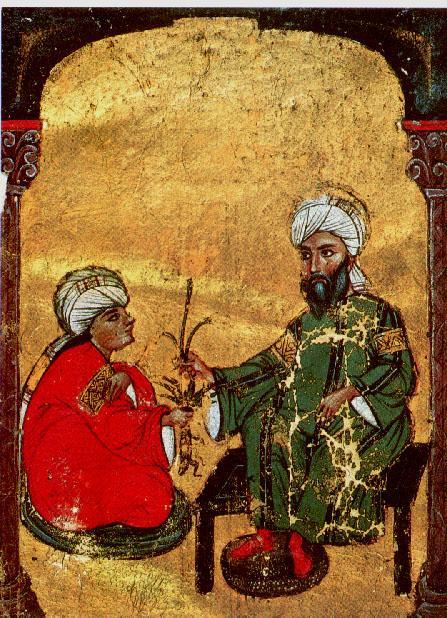
2/21/2009
Supporting Early Math Skills Through Everyday Moments
Supporting Early Math Skills Through Everyday Moments
Children are using early math skills throughout their daily routines and activities. This is good news as these skills are important for being ready for school. But early math doesn’t mean taking out the calculator during playtime. Even before they start school, most children develop an understanding of addition and subtraction through everyday interactions. For example, Thomas has two cars; Joseph wants one. After Thomas shares one, he sees that he has one car left (Bowman B. T. et al., 2001, p. 201). Other math skills are introduced through daily routines you share with your child—counting steps as you go up or down, for example. Informal activities like this one give children a jumpstart on the formal math instruction that starts in school.
What math knowledge will your child need later on in elementary school? Early mathematical concepts and skills that first-grade mathematics curriculum builds on include: (Bowman, B. T., Donovan, M. S., & Burns, M. S., (Eds.), 2001, 76).
# Understanding size, shape, and patterns
# Ability to count verbally (first forward, then backward)
# Recognizing numerals
# Identifying more and less of a quantity
# Understanding one-to-one correspondence (i.e., matching sets, or knowing which group has four and which has five)
Click below to skip to the topic of your choice:
Key Math Skills for School
How Math Skills Link to Other Areas of Development
What You Can Do
Key Math Skills for School
More advanced mathematical skills are based on an early math “foundation”—just like a house is built on a strong foundation. In the toddler years, you can help your child begin to develop early math skills by introducing ideas like: (From Diezmann & Yelland, 2000, and Fromboluti & Rinck, 1999.)
Number Sense: This is the ability to count accurately—first forward. Then, later in school, children will learn to count backwards. A more complex skill related to number sense is the ability to see relationships between numbers—like adding and subtracting.
Ben (age 2) saw the cupcakes on the plate. He counted with his dad: “One, two, three, four, five,
six…”
Representation: Making mathematical ideas “real” by using words, pictures, symbols and objects (like blocks).
Casey (aged 3) was setting out a pretend picnic. He carefully laid out four plastic plates and four plastic cups: “So our whole family can come to the picnic!” There were four members in his family; he was able to apply this information to the number of plates and cups he chose.
Spatial sense: Later in school, children will call this “geometry”. But for toddlers it is introducing the ideas of shape, size, space, position, direction and movement.
Aziz (28 months) was giggling at the bottom of the slide. “What’s so funny?” his Auntie wondered. “I comed up,” said Aziz, “Then I comed down!”
Measurement: Technically, this is finding the length, height, and weight of an object using units like inches, feet or pounds. Measurement of time (in minutes, for example) also falls under this skill area.
Gabriella (36 months) asked her Abuela again and again: “Make cookies? Me do it!” Her Abuela showed her how to fill the measuring cup with sugar. “We need two cups, Gabi. Fill it up once and put it in the bowl, then fill it up again.”
Estimation: This is the ability to make a good guess about the amount of size of something. This is very difficult for young children to do. You can help them by showing them the meaning of words like more, less, bigger, smaller, more than, less than.
Nolan (30 months) looked at the two bagels: one was a regular bagel, one was a mini-bagel. His dad asked: “Which one would you like?” Nolan pointed to the regular bagel. His dad said, “You must be hungry! That bagel is bigger. That bagel is smaller. Okay, I’ll give you the bigger one. Breakfast is coming up!”
Patterns: Patterns are things—numbers, shapes, images—that repeat in a logical way. Patterns help children learn to make predictions, to understand what comes next, to make logical connections, and to use reasoning skills.
Ava (27 months) pointed to the moon: “Moon. Sun go night-night.” Her grandfather picked her up, “Yes, little Ava. In the morning, the sun comes out and the moon goes away. At night, the sun goes to sleep and the moon comes out to play. But it’s time for Ava to go to sleep now, just like the sun.”
Problem-solving: The ability to think through a problem, to recognize there is more than one path to the answer. It means using past knowledge and logical thinking skills to find an answer.
Carl (aged 15 months) looked at the shape-sorter—a plastic drum with 3 holes in the top. The holes were in the shape of a triangle, a circle and a square. Carl looked at the chunky shapes on the floor. He picked up a triangle. He put it in his month, then banged it on the floor. He touched the edges with his fingers. Then he tried to stuff it in each of the holes of the new toy. Surprise! It fell inside the triangle hole! Carl reached for another block, a circular one this time… Back to Top
Math: One Part of the Whole
Math skills are just one part of a larger web of skills that children are developing in the early years—including language skills, physical skills, and social skills. Each of these skill areas is dependent on and influences the others.
Trina (aged 18 months) was stacking blocks. She had put two square blocks on top of one another, then a triangle block on top of that. She discovered that no more blocks would balance on top of the triangle-shaped block. She looked up at her dad and showed him the block she couldn’t get to stay on top, essentially telling him with her gesture, “Dad, I need help figuring this out.” Her father showed her that if she took the triangle block off and used a square one instead, she could stack more on top. She then added two more blocks to her tower before proudly showing her creation to her dad: “Dada, Ook! Ook!”
You can see in this ordinary interaction how all areas of Trina’s development are working together. Her physical ability allows her to manipulate the blocks and use her thinking skills to execute her plan to make a tower. She uses her language and social skills as she asks her father for help. Her effective communication allows Dad to respond and provide the helps she needs (further enhancing her social skills as she sees herself as important and a good communicator). This then further builds her thinking skills as she learns how to solve the problem of making the tower taller. Back to Top
What You Can Do
The tips below highlight ways that you can help your child learn early math skills by building on their natural curiosity and having fun together. (Note: Most of these tips are designed for older children—ages 2-3. Younger children can be exposed to stories and songs using repetition, rhymes and numbers.)
* Shape up. Play with shape-sorters. Talk with your child about each shape—count the sides, describe the colors. Make your own shapes by cutting large shapes out of colored construction paper. Ask your child to “hop on the circle” or “jump on the red shape.”
* Count and sort. Gather together a basket of small toys, shells, pebbles or buttons. Count them with your child. Sort them based on size, color, or what they do (i.e., all the cars in one pile, all the animals in another).
* Place the call. With your three year old, begin teaching her the address and phone number of your home. Talk with your child about how each house has a number, and how their house or apartment is one of a series, each with its own number.
* What size is it? Notice the sizes of objects in the world around you: That pink pocketbook is the biggest. The blue pocketbook is the smallest. Ask your child to think about his own size relative to other objects (“Do you fit under the table? Under the chair?”).
* You’re cookin’ now! Even young children can help fill, stir, and pour. Through these activities, children learn, quite naturally, to count, measure, add, and estimate.
* Walk it off. Taking a walk gives children many opportunities to compare (which stone is bigger?), assess (how many acorns did we find?), note similarities and differences (does the duck have fur like the bunny does?) and categorize (see if you can find some red leaves). You can also talk about size (by taking big and little steps), estimate distance (is the park close to our house or far away?), and practice counting (let's count how many steps until we get to the corner).
* Picture time. Use an hourglass, stopwatch, or timer to time short (1-3 minute) activities. This helps children develop a sense of time and to understand that some things take longer than others.
* Shape up. Point out the different shapes and colors you see during the day. On a walk, you may see a triangle-shaped sign that’s yellow. Inside a store you may see a rectangle-shaped sign that’s red.
* Read and sing your numbers. Sing songs that rhyme, repeat, or have numbers in them. Songs reinforce patterns (which is a math skill as well). They also are fun ways to practice language and foster social skills like cooperation.
* Start today. Use a calendar to talk about the date, the day of the week, and the weather. Calendars reinforce counting, sequences, and patterns. Build logical thinking skills by talking about cold weather and asking your child: What do we wear when it’s cold? This encourages your child to make the link between cold weather and warm clothing.
* Pass it around. Ask for your child’s help in distributing items like snacks or in laying napkins out on the dinner table. Help him give one cracker to each child. This helps children understand one-to-one correspondence. When you are distributing items, emphasize the number concept: “One for you, one for me, one for Daddy.” Or, “We are putting on our shoes: One, two.”
* Big on blocks. Give your child the chance to play with wooden blocks, plastic interlocking blocks, empty boxes, milk cartons, etc. Stacking and manipulating these toys help children learn about shapes and the relationships between shapes (e.g., two triangles make a square). Nesting boxes and cups for younger children help them understand the relationship between different sized objects.
* Tunnel time. Open a large cardboard box at each end to turn it into a tunnel. This helps children understand where their body is in space and in relation to other objects.
* The long and the short of it. Cut a few (3-5) pieces of ribbon, yarn or paper in different lengths. Talk about ideas like long and short. With your child, put in order of longest to shortest.
* Learn through touch. Cut shapes—circle, square, triangle—out of sturdy cardboard. Let your child touch the shape with her eyes open and then closed.
* Pattern play. Have fun with patterns by letting children arrange dry macaroni, chunky beads, different types of dry cereal, or pieces of paper in different patterns or designs. Supervise your child carefully during this activity to prevent choking, and put away all items when you are done.
* Laundry learning. Make household jobs fun. As you sort the laundry, ask your child to make a pile of shirts and a pile of socks. Ask him which pile is the bigger (estimation). Together, count how many shirts. See if he can make pairs of socks: Can you take two socks out and put them in their own pile? (Don’t worry if they don’t match! This activity is more about counting than matching.)
* Playground math. As your child plays, make comparisons based on height (high/low), position (over/under), or size (big/little).
* Dress for math success. Ask your child to pick out a shirt for the day. Ask: What color is your shirt? Yes, yellow. Can you find something in your room that is also yellow? As your child nears three and beyond, notice patterns in his clothing—like stripes, colors, shapes, or pictures: I see a pattern on your shirt. There are stripes that go red, blue, red, blue. Or, Your shirt is covered with ponies—a big pony next to a little pony, all over your shirt!
* Graphing games. As your child nears three and beyond, make a chart where your child can put a sticker each time it rains or each time it is sunny. At the end of a week, you can estimate together which column has more or less stickers, and count how many to be sure. Back to Top
References:
Bowman, B. T., Donovan, M. S., & Burns, M. S., (Eds.). (2001). Eager to learn: Educating our preschoolers. Washington, DC: National Academy of Sciences.
Diezmann, C., & Yelland, N. J. (2000). Developing mathematical literacy in the early childhood years. In Yelland, N. J. (Ed.), Promoting meaningful learning: Innovations in educating early childhood professionals. (pp.47-58). Washington, DC: National Association for the Education of Young Children.
Fromboluti, C. S., & Rinck, N. (1999 June). Early childhood: Where learning begins.
U.S. Department of Education, Office of Educational Research and Improvement,
National Institute on Early Childhood Development and Education. Retrieved on September 22, 2008 from http://www.kidsource.com/education/math/whatis.html
0-3

Helping Young Children Channel Their Aggression
Helping Young Children Channel Their Aggression
Ask any parent whether she wants her child to be an aggressive person and you are likely to get more than one answer. After all, aggression is associated with both approved and disapproved behavior in our minds and in our society—both with the energy and purpose that help us to actively master the challenges of life and with hurtful actions and destructive forces.
Most of us want our children to be able to take a stand for themselves when others treat them roughly. We hope that they will not start fights but if attacked will be able to cope with the attacker and not be overwhelmed. A child's learning to find a healthy balance between too much and too little aggressive behavior is probably the most difficult task of growing up.
According to developmental theory, aggressive impulses or drives are born in the human child and are a crucial aspect of the psychological life-force and of survival. In the course of healthy development, these drives are normally expressed in various behaviors at different ages and, with assistance from parents and others, are gradually brought under the control of the individual—moderated, channeled and regulated but by no means stamped out.
Aggression is Part of Healthy Development
During the first year, infants are not often thought of as behaving aggressively, and yet encounters in which an infant pushes, pulls, or exerts force against another are signs of the outwardly directed energy and assertiveness that reflect the healthy maturation of aggression. But the nine-month old who pulls your hair does not know that it might hurt—it is done in the same exuberant, playful spirit that is seen in other activities. It is only in the second year, when the child develops a better awareness of his separateness as a person—of "me" and "you"—that he can begin to understand that he is angry at someone and behave with intentional force. We do not usually talk about a child's being cruel or hostile toward others until some time during the second years. Even then, he does not know enough about cause and effect to understand the consequences of his action or how to regulate this behavior toward others. When your fifteen-month-old smashes a fragile object, he is caught up in the pleasure of assertiveness, not anticipating its result.
Parents sometimes tell me about their toddler who "knows better" than to hit or bite. They believe this is so because when he is scolded, he looks ashamed. What the toddler understands is not that he has hurt someone or destroyed something but that he has earned the disapproval of his parents. Conversely, when praised for being gentle with another, he knows and is pleased that he is approved of for that behavior at that moment. It will take time and many reminders before he can understand that not hitting or biting applies to many situations. Young children, particularly those under three and a half or so, scarcely know their own strength. The differences between a kiss and a bite, between patting and hitting, between nudging and pushing someone down are not automatically understood and children need many reminders: e.g., "Let me show you how to pat the baby (or the family dog or Daddy's cheek)"; "Patting feels nice. Hitting can hurt"; or "Do it softly (or gently), like this."
Learning "What to Expect" at Different Ages and Stages
As is true of the young child's development in other areas, there are steps and phases in the socialization of aggression, and it is worth your while to learn something about what kind of behavior to expect at various ages. If you understand what an infant or toddler or a four-year-old is capable of you can adjust your own actions and teaching to realistic expectations and save yourself worry and frustration. You don't need the anxiety of imagining that your toddler who gets very angry and has very little control over his aggression when frustrated or upset is destined to become an angry, destructive, uncontrolled four-or ten-or twenty-year-old. On the other hand, if your four-year-old has frequent aggressive outbursts and seems not to be concerned about the effect of his aggression, or even seems to enjoy hurting others, you are correct in being worried and in seeking ways to help him toward healthier behavior.
Parenting Strategies for Managing Aggression in Very Young Children
How then do parents moderate and channel their child's aggression without stamping it out by being too severe? While there is no exact recipe, here are twelve suggestions that may help you to provide your child with the guidance he needs.
1. Limits are part of loving. Keep in mind that your child's feeling loved and affectionately cared for builds the foundation for his acceptance of the guidance you will provide as he grows. Children who feel loved want to please their parents most of the time and will respond to their guidance. Putting reasonable restrictions on your child's behavior is part of loving him, just as are feeding, comforting, playing and responding to his wishes.
2. Try to figure out what triggered your child's aggressive behavior. Ask yourself what might have happened that set him off—your behavior or that of another person, or something else in the situation; perhaps he is overtired or not feeling well physically. Being rushed, abruptly handled, being denied something he wants, even being unable to do something he has tried to do with a toy or physical activity often produces feelings of frustration and anger that result in aggressive behavior.
3. Use what you know. Make use of what you know about your child's temperament, rhythms, preferences, and sensitivities. For example, if you know that he is irritable or ill-humored for the first hour of the day or gets very out of sorts when tired or hungry, you won't pick that time to ask a great deal in the way of control.
4. Be clear. Tell your child what you want him to do or not do in a specific situation (but try not to give a long lecture). Your child will be aware of your displeasure from your tone of voice as well as from what you say. It is important that you try to be clear about your disapproval. However, long lectures and dire predictions are usually counterproductive. Telling a three-year-old child that she can't have any television for two weeks if she hits her baby brother may upset her, but it is unlikely to help her understand and develop her own controls. A better reason is that you don't want her to hit him because it hurts. That you don't like the behavior is your most effective message. It helps any young child who has earned the disapproval of a parent to be reminded that she is loved even when you don't like the behavior.
5. Be a careful observer. When your young child is playing with other children, keep an eye on the situation but try not to hover. What begins as playful scuffling or run and chase or sharing toys can quickly move into a battle between children, and they may need a referee. However, there are times when you can let young children work things out among themselves. Age makes a difference, of course.
6. Use redirection. When your child is being aggressive in ways you don't like, stop the behavior and give him something else to do. You may either suggest and help start a new activity or perhaps guide him to a place where he can discharge aggressive feelings without doing harm to himself, to anyone else, to toys, or to the family pet. For example, a corner in which there is something to punch or bang or throw at can be utilized. You can say, for example, "If you feel like hitting, go and hit your pillow (or punching bag), but you can't hit the dog (or bang the table with a hammer)." Such an opportunity not only helps the child discharge some aggressive feelings but also helps him understand that there can be a time and place provided for such actions.
7. Be a coach. When time permits, demonstrate how to handle a situation in which there is conflict between children. For instance, if your child is old enough, you can teach him a few words to use in order to avoid or settle a conflict. A two-year-old can be helped to hold on to a toy and say "no" or "mine" instead of always pushing or crying when another child tries to take a toy. Children need specific suggestions and demonstrations from adults in order to learn that there are effective ways to handle disagreements that are more acceptable than physical attack and retaliation.
8. Use language. If your child has language skills, help him explain what he is angry about. If you are able to guess and he cannot say, do it for him, e.g., "I guess you're mad because you can't go to play with Johnny. I know how you feel, but it's too late to go today" (or whatever the reason is).
9. Ask yourself if you are sending "mixed messages" to your child about his aggressiveness. If you say "Don't hit" or "Be nice" while you are not so secretly enjoying your child's aggressive behavior toward someone else, he will be confused, and such confusions tend to make it more difficult to develop self-control.
10. Be a role model. Keep in mind that parents are the most important models for behavior and how to use aggression in a healthy way. If social exchanges in your family include much arguing or physical fighting in the presence or hearing of your children, you can count on their picking it up. Home environments like these can be unsafe and unhealthy for everyone in the family. If you are coping with a violent partner, call the National Domestic Violence Hotline at 1-800-799-7233 or 1-800-787-3244 (TTY) for support, shelter, or services, or visit Stop Family Violence for more information on getting the support and help you need.
11. Avoid spanking. Think about the very real disadvantages of physical punishment for your child. Children often arouse anger in adults when they provoke, tease, behave stubbornly, or attack others. If your practice is to hit or physically punish your child in some other way for such behavior, you need to think very carefully about what he learns from that.
12. Be patient; learning takes time. Your child's learning to love and live in reasonable harmony with others comes about only gradually and over many years. For you as parents there will always be ups and downs, periods when you despair of "civilizing" your child or when you will worry that he will be too timid for the rigors of the world. While living from day to day with the pleasures and frustrations of being a parent, it is also important to keep the long view in mind: there is a positive momentum to development. This forward thrust of your child's growth and development actually works in favor of his acquiring the ability to channel and productively use those aggressive energies that are a vital part of our makeup.
Sally Provence, M.D.
0-3
Choosing Toys for Toddlers
"Toddlers are little explorers who learn by doing. Play gives your child a great opportunity to develop and practice new skills at her own pace by following her unique interests. The toys and playthings your child has available to her can shape her development in important ways.
While it may seem like choosing toys for toddlers should be easy, as you walk into a toy store today, the only thing that’s easy is feeling overwhelmed. There is a huge array of toys that have been developed for the toddler market. How do you choose which are right for your child? How can you tell which are high quality and which will last? Which will engage your child’s interest for more than a few days or weeks? Below are some ideas for choosing toys that will grow with your child, challenge her, and nurture her overall development (her thinking, physical, language and social-emotional skills).
Guidelines for Choosing Toys for Toddlers
* Choose toys that can be used in a variety of ways. Toddlers love to take apart, put back together, pull out, put in, add on, and build up. Choose toys that are “open-ended” in the sense that your child can play many different games with them. For example, wooden blocks or chunky plastic interlocking blocks can be used to make a road, a zoo, a bridge or a spaceship. Toys like this spark your child’s imagination and help him develop problem-solving and logical thinking skills.
Examples: Blocks, interlocking blocks, nesting blocks or cups, and toys for sand and water play
* Look for toys that will grow with your child. We all have had the experience of buying a toy that our child plays with for two days and never touches again. You can guard against that by looking for toys that can be fun at different developmental stages. For example, small plastic animals are fun for a young toddler who may make a shoebox house for them, while an older toddler can use them to act out a story she makes up.
Examples: Plastic toy animals and action figures, toddler-friendly dollhouses, trains and dump trucks (and other vehicles), stuffed animals and dolls
* Select toys that encourage exploration and problem-solving. Play gives children the chance to practice new skills over and over again. Toys that give kids a chance to figure something out on their own—or with a little coaching—build their logical thinking skills and help them become persistent problem-solvers. They also help children develop spatial relations skills (understanding how things fit together), hand-eye coordination, and fine motor skills (using the small muscles in the hands and fingers).
Examples: Puzzles, shape-sorters, blocks, nesting blocks or cups, art materials like clay, paint, crayons or play-dough
* Look for toys that spark your child’s imagination. During your child’s third year, her creativity is really taking off as she is now able to take on the role of someone else (like a king) and imagine that something (like a block) is actually something else (like a piece of cake). Look for toys that your child can use as he develops and acts out stories. Pretend play builds language and literacy skills, problem-solving skills, and the ability to sequence (put events in a logical order).
Examples: Dress-up clothing, blocks, toy food and plastic plates, action figures, stuffed animals and dolls, trains and trucks, toddler-friendly dollhouses, toy tools, and “real-life” accessories such as a wrapping paper tube “fire hose” for your little fire fighter. The all-purpose large cardboard box is always a big hit for toddlers and is free. (Call an appliance store about picking up one of their refrigerator boxes). Boxes become houses, pirate ships, barns, tunnels—anything your child’s imagination can come up with!
* Give your child the chance to play with “real” stuff—or toys that look like the real thing. Your toddler is getting good at figuring out how objects in her world work—like television remotes or light switches. She is also interested in playing with your “real” stuff, like your cell phone, because she is eager to be big and capable like you. Toys like this help children problem-solve, learn spatial relations (how things fit together), and develop fine motor skills (use of the small muscles in the hands and fingers).
Examples: Plastic dishes and food, toy keys, toy phone, dress-up clothes, musical instruments, child-size brooms, mops, brushes and dustpans
* Toss in some “getting ready to read” toys. Books, magnetic alphabet letters, and art supplies like markers, crayons, and fingerpaints help your child develop early writing and reading skills. “Real-life” props like take-out menus, catalogs or magazines are fun for your child to look at and play with and also build her familiarity with letters, text, and print.
* Seek out toys that encourage your child to be active. Toddlers are doing all kinds of physical tricks as they are stronger and more confident with their bodies. Your job is to be an appreciative audience for your little one’s newest playground achievement! Look for toys that help your child practice current physical skills and develop new ones.
Examples: Balls of different shapes and sizes, tricycles or three-wheeled scooters (with appropriate protective gear), plastic bowling sets, child-size basketball hoop, pull-toys (e.g., toys that your child can pull on a string), wagon to fill and pull, gardening tools to dig and rake with, moving boxes (open at both ends) to make tunnels to crawl through
* Look for toys that nurture cross-generational play. While adults and children can play almost anything together, there are some toys that are designed for adult participation. As your child approaches age 3 and beyond, early board games—that involve using one’s memory or simple board games that do not require reading—are fun for all ages to play. Consider starting a “family game night” when all of you play together. Board games encourage counting, matching and memory skills, as well as listening skills and self-control (as children learn to follow the rules). They also nurture language and relationship-building skills. Another important benefit is teaching children to be gracious winners and how to cope with losing."
Common Questions on Choosing Toys for Toddlers
What are the benefits of sounds, lights and music?
Many, many toys for toddlers are ablaze with buttons, levers, lights, music, etc. Often these toys are marketed as “developmental” because the toy has so many different functions. Unfortunately, this often has the opposite effect for the child. The more a toy does, the less your child has to do. If your child can sit and watch the toy “perform”, then it is likely more entertaining than educational. In addition, these toys can be confusing to a child who is learning cause-and-effect. If a toy randomly starts playing music, or it is unclear which button made the lights start flashing, then your child is not learning which of his actions (the cause) produced the lights and music (the effect). In short, the most useful toys are those that require the most action on the part of a young child. The more children have to use their minds and bodies to make something work, the more they learn.
Can toys actually “make my baby smarter”, as the packaging and advertisements often claim?
Proceed with caution. Most products that make these claims have not been proven to increase children’s intelligence. In fact, safe household items (plastic bowls for filling and dumping, pillows for climbing and piling up to make a cave, old clothing for dress-up) are often the best learning tools. Remember, the more your child has to use his mind and body to problem solve and develop his own ideas, the more he learns.
0-3

2/17/2009
Learning in the Age of Television
Learning in the Age of Television
By Neil Postman
There could not have been a safer bet when it began in 1969 than that "Sesame Street" would be embraced by children, parents, and educators. Children loved it because they were raised on television commercials, which they intuitively knew were the most carefully crafted entertainments on television. To those who had not yet been to school, even to those who had just started, the idea of being taught by a series of commercials did not seem peculiar. And that television should entertain them was taken as a matter of course.
Parents embraced "Sesame Street" for several reasons, among them that it assuaged their guilt over the fact that they could not or would not restrict their children's access to television. "Sesame Street" appeared to justify allowing a 4- or 5-year-old to sit transfixed in front of a television screen for unnatural periods of time. Parents were eager to hope that television could teach their children something other than which breakfast cereal has the most crackle. At the same time, "Sesame Street" relieved them of the responsibility of teaching their preschool children how to read--no small matter in a culture where children are apt to be considered a nuisance.
They could also plainly see that in spite of its faults, "Sesame Street" was entirely consonant with the prevailing spirit of America. Its use of cute puppets, celebrities, catchy tunes, and rapid-fire editing was certain to give pleasure to the children and would therefore serve as adequate preparation for their entry into a fun-loving culture.
As for educators, they generally approved of "Sesame Street," too. Contrary to common opinion, they are apt to find new methods congenial, especially if they are told that education can be accomplished more efficiently by means of the new techniques. (That is why such ideas as "teacher-proof" textbooks, standardized tests, and, now, microcomputers have been welcomed into the classroom.) "Sesame Street" appeared to be an imaginative aid in solving the growing problem of teaching Americans how to read, while, at the same time, encouraging children to love school. We now know that "Sesame Street" encourages children to love school only if school is like "Sesame Street." Which is to say, we now know that "Sesame Street" undermines what the traditional idea of schooling represents.
Whereas a classroom is a place of social interaction, the space in front of a television set is a private preserve. Whereas in a classroom, one may ask a teacher questions, one can ask nothing of a television screen. Whereas school is centered on the development of language, television demands attention to images. Whereas attending school is a legal requirement, watching television is an act of choice. Whereas in school, one fails to attend to the teacher at the risk of punishment, no penalties exist for failing to attend to the television screen. Whereas to behave oneself in school means to observe rules of public decorum, television watching requires no such observances, has no concept of public decorum. Whereas in a classroom, fun is never more than a means to an end, on television it is the end in itself.
Yet "Sesame Street" and its progeny, "The Electric Company," are not to be blamed for laughing the traditional classroom out of existence. If the classroom now begins to seem a stale and flat environment for learning, the inventors of television itself are to blame, not the Children's Television Workshop. We can hardly expect those who want to make good television shows to concern themselves with what the classroom is for. They are concerned with what television is for.
This does not mean that "Sesame Street" is not educational. It is, in fact, nothing but educational--in the sense that every television show is educational. Just as reading a book--any kind of book--promotes a particular orientation toward learning, watching a television show does the same. "The Little House on the Prairie," "Cheers," and "The Tonight Show" are as effective as "Sesame Street" in promoting what might be called the television style of learning. And this style of learning is, by its nature, hostile to what has been called book learning or its handmaiden, school learning.
If we are to blame "Sesame Street" for anything, it is for the pretense that it is an ally of the classroom. That, after all, has been its chief claim on foundation and public money. As a television show, and a good one, "Sesame Street" does not encourage children to love school or anything about school. It encourages them to love television.
Moreover, it is important to add that whether or not "Sesame Street'' teaches children their letters and numbers is entirely irrelevant. We may take as our guide here John Dewey's observation that the content of a lesson is the least important thing about learning. As he wrote in Experience and Education: "Perhaps the greatest of all pedagogical fallacies is the notion that a person learns only what he is studying at the time. Collateral learning in the way of formation of enduring
attitudes ... may be and often is more important than the spelling lesson or lesson in geography or history. ... For these attitudes are fundamentally what count in the future." In other words, the most important thing one learns is always something about how one learns. As Dewey wrote in another place, we learn what we do.
Television educates by teaching children to do what television viewing requires of them. And that is as precisely remote from what a classroom requires of them as reading a book is from watching a stage show.
Although one would not know it from consulting various recent proposals on how to mend the educational system, this point--that reading books and watching television differ entirely in what they imply about learning--is the primary educational issue in America today. America is, in fact, the leading case in point of what may be thought of as the third great crisis in Western education. The first occurred in the 5th century B.C., when Athens underwent a change from an oral culture to an alphabet-writing culture. To understand what this meant, we must read Plato. The second occurred in the 16th century, when Europe underwent a radical transformation as a result of the printing press. To understand what this meant, we must read John Locke. The third is happening now, in America, as a result of the electronic revolution, particularly the invention of television. To understand what this means, we must read Marshall McLuhan.
We face the rapid dissolution of the assumptions of an education organized around the slow-moving printed word, and the equally rapid emergence of a new education based on the speed-of-light electronic image. The classroom is, at the moment, still tied to the printed word, although that connection is rapidly weakening. Meanwhile, television forges ahead, making no concessions to its great technological predecessor, creating new conceptions of knowledge and how it is acquired. One is entirely justified in saying that the major educational enterprise now being undertaken in the United States is not happening in its classrooms but in the home, in front of the television set, and under the jurisdiction not of school administrators and teachers but of network executives and entertainers.
I don't mean to imply that the situation is a result of a conspiracy or even that those who control television want this responsibility. I mean only to say that, like the alphabet or the printing press, television has by its power to control the time, attention, and cognitive habits of our youth gained the power to control their education. This is why I think it accurate to call television a curriculum. As I understand the word, a curriculum is a specially constructed information system whose purpose is to influence, teach,
train, or cultivate the mind and character of youth. Television, of course, does exactly that, and does it relentlessly. In so doing, it competes successfully with the school curriculum. By which I mean, it damn near obliterates it. Television's principal contribution to educational philosophy is the idea that teaching and entertainment are inseparable. This entirely original conception is to be found nowhere in educational discourse, from Confucius to Plato to Cicero to Locke to John Dewey. In searching the literature of education, you will find it said by some that children will learn best when they are interested in what they are learning. You will find it said--Plato and Dewey emphasized this--that reason is best cultivated when it is rooted in robust emotional ground. You will even find some who say that learning is best facilitated by a loving and benign teacher. But no one has ever said or implied that significant learning is effectively, durably, and truthfully achieved when education is entertainment.
Education philosophers have assumed that becoming acculturated is difficult because it necessarily involves the imposition of restraints. They have argued that there must be a sequence to learning, that perseverance and a certain measure of perspiration are indispensable, that individual pleasures must frequently be submerged in the interests of group cohesion, and that learning to be critical and learning to think conceptually and rigorously do not come easily to the young but are hard-fought victories. Indeed, Cicero remarked that the purpose of education is to free the student from the tyranny of the present, which cannot be pleasurable for those, like the young, who are struggling hard to do the opposite--that is, accommodate themselves to the present.
Television offers a delicious and original alternative to all of this. We might say there are three commandments that form the philosophy of the education which television offers. The influence of these commandments is observable in every type of television programming--from "Sesame Street" to the documentaries of "Nova" and "The National Geographic" to "Fantasy Island" to mtv The commandments are as follows: Thou shalt have no prerequisites. Every television program must be a complete package in itself. No previous knowledge is to be required. There must not be even a hint that learning is hierarchical, that it is an edifice constructed on a foundation. The learner must be allowed to enter at any point without prejudice. This is why you shall never hear or see a television program begin with the caution that if the viewer has not seen the previous programs, this one will be meaningless.
Television is a nongraded curriculum and excludes no viewer for any reason, at any time. In other words, in doing away with the idea of sequence and continuity in education, television undermines the idea that sequence and continuity have anything to do with thought itself. Thou shalt induce no perplexity.
In television teaching, perplexity is a superhighway to low ratings. A perplexed learner is a learner who will turn to another station. This means that there must be nothing that has to be remembered, studied, applied, or, worst of all, endured. It is assumed that any information, story, or idea can be made immediately accessible, since the contentment, not the growth, of the learner is paramount. Thou shalt avoid exposition like the 10 plagues visited upon Egypt.
Of all the enemies of television teaching, including continuity and perplexity, none is more formidable than exposition. Arguments, hypotheses, discussions, reasons, refutations, or any of the traditional instruments of reasoned discourse turn television into radio or, worse, third-rate printed matter. Thus, television teaching always takes the form of storytelling, conducted through dynamic images and supported by music. This is as characteristic of "Star Trek" as it is of "Cosmos," of "Diff'rent Strokes" as of "Sesame Street," of commercials as of "Nova." Nothing will be taught on television that cannot be both visualized and placed in a theatrical context.
The name we may properly give to an education without prerequisites, perplexity, and exposition is entertainment. And when one considers that save for sleeping there is no activity that occupies more of an American youth's time than television viewing, we cannot avoid the conclusion that a massive reorientation toward learning is now taking place.
PdF file
Neil Postman, professor of communication arts and sciences at New York University, is the author of Amusing Ourselves to Death: Public Discourse in the Age of Show Business, Teaching as a Subversive Activity, The Disappearance of Childhood, and other books.
2/15/2009
Pavlovian Paradise?
I wonder if its because of living under authoritative governments (dictatorships,oligarchy, etc.) that most immigrants feel the need to impose an 'authoritative' Islam in their communities? (That's all we know baby and we're sticking to it.) We don't understand the concept of an 'opposition party,' nor care about respecting opposing views. There's no room for that in our black and white world. All we want is someone to tell us what to do, so we can tell someone weaker what to do, because that's how it was done back home.

2/11/2009
I just want to know...
I’m a huge 'Lost' fan. Really, I stay up for hours, after putting my household to bed, researching theories and reviewing old episodes. Last night at about 2:30 in the morning I kind of wondered what the hell is wrong with me. Why can’t I just be content with what’s plain and obvious? Why am I obsessed with solving mysteries, finding clues, trying to understand the big picture? What is it about time travel, worm holes, and negative energy that can’t wait until the next day? Why am I so intrigued with the unexplained correlations that exist between the characters?
Well, duh, maybe because it’s the story of my life?
I’m a lost spirit (definitely not from this world) who travels to distance places in her sleep each night. The morning after I don’t remember a thing, I don’t even know what I look like while I’m... erm, traveling. I’m on this island, situated in some remote part of the galaxy, trying to link all the subtle clues [of my existence?] in order to find my ultimate answer. My ultimate destination...
Life is mysterious. (stranger than fiction really). It is full of wonders and excitement. (if you take the time to observe). But most of all it reminds us that we’re all meant to be something magnificent. (We’re destined for greatness). We just don’t know it yet.
Some of us just don’t know what our purpose is just yet; maybe that’s why we struggle. We struggle with mediocrity but hope for something more. We search the universe for clues but always return to the self for self-assurance. Ultimately, the answers lie beneath the surface, within our very heart, that carries some of the secrets of the unseen; probably the only object that can truly understand the true purpose of being.
so if i repair my heart, i will know the ending of 'Lost?' Huh? Oh look, it's 2:30 am again. Wee!
1/25/2009
Neil Postman
"Children are the living messages we send to a time we will not see."
"Television is altering the meaning of "being informed" by creating a species of information that might properly be called disinformation. Disinformation does not mean false information. It means misleading information - misplaced, irrelevant, fragmented or superficial information - information that creates the illusion of knowing something, but which in fact leads one away from knowing."
Neil Postman
1/23/2009
Mysticism in Islam
Mysticism in Islam
William C. Chittick
"It is worth noting that modern-day "Islamism"—that is, ideological posturing and political activism in the name of Islam —agrees with the early Orientalists on the origins of Islamic mysticism. Despite the fact that the Islamists are harshly critical of Western scholarship, they adopt many of its positions. They love Western technological expertise along with its guns and bombs, and they also love the various political theories that justify totalitarian control. By claiming that mysticism derives from outside sources, they embrace the Orientalist myth of a harsh and sterile Islam and ignore the spiritual and intellectual heritage of their religion. They have focused all their efforts on turning people away from the Islamic tradition and establishing authoritarian regimes."
It's been a long time...
Wow, time flies. Mostly, it drags but sometimes it flies. I feel like my brain stopped working for a while. But I am back.
3/25/2008
Wisdom
"We live in a world bound by these four essential Divine Attributes. We come from God; we return to God; God resides inwardly at the centre of our being; and the world itself is nothing but levels of Divine Presence which, however, is not perceivable as such save with the eye of inwardness. Happy is the person who before he is forced to open his eyes at the moment of death realizes this truth while in this life and with full possession of the gift of free will. Such a person will not but seek to serve, to love and to know God and through the realization thus gained be a true light to the world of service to both human beings and God’s other creatures, lover of the good and the beautiful and of all of God’s creation and locus of that unitive and illuminative knowledge of God which is the ultimate purpose of creation and the fountainhead of all wisdom."
GOD: THE REALITY TO SERVE,
LOVE AND KNOW
Seyyed Hossein Nasr
Dua
My Lord,
Let my breast have a heart that is aware;
Give me an eye that will see, in the wine,
The intoxicating power of the wine.
This bondsman, who never lived by others' breath,
Give him a sigh that is native to him,
A sigh that is like dawn.
I am a flood, do not make me writhe in a shallow stream;
Give me, for playground, mountains and valleys.
If You would pit me against the boundless sea,
Give me, along with the restlessness of the wave,
The calm of the pearl.
You have set my eagle to hunt leopards;
Give him high resolve, and claws that are sharper.
I have set out to hunt the birds of the Sanctuary;
Give me an arrow that will hit the mark unshot.
I am but dust, set me afire with the light of David's song;
Give, to every particle of my being, wings of sparks.
IQBAL
Kulliyyāt-i Iqbāl-Fārsī (Lahore: Iqbal Academy Pakistan, 1990), p. 354.
Can the Islamic Intellectual Heritage be Recovered?
Can the Islamic Intellectual Heritage be Recovered?
William C. Chittick
By "the Islamic intellectual heritage" I mean the ways of thinking about God, the world, and the human being established by the Qur’«n and the Prophet and elaborated upon by generations of practicing Muslims. I use the term "intellectual" to translate the word ‘aqlâ, and by it I want to distinguish this heritage from another, closely related heritage that also has theoretical and intellectual dimensions. This second heritage is the "transmitted" (naqlâ ) heritage.
Transmitted knowledge is learned by "imitation" (taqlâd), that is, by following the authority of those who possess it. This sort of knowledge includes Qur’«n recitation, Hadith, Arabic grammar, and jurisprudence. It is impossible to be a Muslim without taqlâd, because one cannot discover the Qur’«n or the practices of the Shariah by oneself. Just as language is learned by imitation, so also the Qur’«n and Islamic practice are learned by imitating those who know them. Those who have assumed the responsibility of preserving this transmitted heritage are known as its "knowers," that is, its ulama.
In transmitted knowledge, it is not proper to ask "why." If one does ask why, the answer is that the Qur’«n says what it says, or that grammar determines the rules of proper speech. In contrast, the only way to learn intellectual knowledge is to understand it. One cannot learn it by accepting it on the basis of authority. Intellectual knowledge includes mathematics, logic, philosophy, and much of theology. In learning, "why" is the most basic and important of questions. If one does not understand why, then one will be following someone else’s authority. It makes no sense to accept that 2 + 2 = 4 on the basis of a report, no matter how trust worthy the source may be. Either you understand it, or you do not. The goal here is not taqlâd, but taÁqâq, which can be translated as "verification" or "realization."
In the transmitted sciences, people must follows mujtahids, whether the mujtahids be alive (as in Shi’ism) or dead (as in Sunnism). In other words, one follows a mujtahid because the only way to learn the transmitted sciences is from those who already know them. But one cannot follow a mujtahid in matters of faith, because faith pertains to one’s own understanding of God, the prophets, the scriptures, and the Last Day. A Muslim cannot say, "I have faith in God because my mujtahid told me to have faith." Someone who said this would be saying that if the mujtahid told him not to believe in God, he would not. In other words, he would be saying that his faith is empty words.
Although in theory we can distinguish between the transmitted and intellectual sciences, in practice the two have always been closely interrelated, and the transmitted sciences have been the foundation upon which the intellectual sciences are built. One cannot speak properly without grammar, and one cannot understand things Islamically without the Qur’«n and the Hadith. However, the fact that people may have an excellent knowledge of the transmitted sciences does not mean that they know anything at all about the intellectual sciences. Nor does the ability to recite the opinions of the great Muslims on matters of faith prove that the reciter has any understanding of what he is saying.
Both the transmitted and the intellectual sciences are essential to the survival of any religion—not only Islam—and both are gradually being lost. By and large, however, the transmitted sciences have been preserved better than the intellectual sciences, and the reason is obvious. Anyone can learn Qur’«n and Hadith, but very few people can truly understand what God and the Prophet are talking about. One can only understand in one’s own measure. One cannot understand mathematics (or any of the other intellectual sciences) without both native ability and training. One may have a great aptitude for mathematics, but without long years of study, one will never get very far. And mathematics deals with issues that are relatively near at hand, even in the most sophisticated of its modern forms. What about theology, which deals with the deepest issues of reality, the furthest from our everyday experience?
It is important to stress that no religion can survive, much less flourish, without a living intellectual tradition. In order to verify this—because this statement should not be accepted on the basis of taqlâd —we can ask the questions, What was the intellectual tradition for? What function did it play in Islamic society? What was its goal? To ask these questions is the same as asking, "Why should Muslims think?" The basic answer is that Muslims should think because they must think, because they are thinking beings. They have no choice but to think, because God gave them minds and intelligence when He created them. Not only that, but God has commanded them to think and to employ their intelligence in numerous Qur,«nic verses.
No doubt, this does not mean that God requires all Muslims to enter into the sophisticated sort of study and reflection that went on in the intellectual tradition, because it is obvious that not everyone has the proper sort of talents, capacities, and circumstances to do so. Nevertheless, all Muslims have the moral and religious obligation to use their minds correctly—if they have minds. As the Qur’«n puts it, l« yukallifu All«hu nafsan ill« wus‘ah«, "God does not burden any soul save to its capacity." When people’s capacity includes thinking, God has given them the burden of thinking correctly. But He does not tell them what to think, because then He would be making taqlâd incumbent in intellectual matters. If many of the Ulama have forbidden taqlâd in matters of uÄël, it is because God Himself forbids it. He has given people minds, and they cannot use their minds correctly if they simply accept dogma or opinions on the basis of authority. To think properly a person must actually think, which is to say that conclusions must be reached through one’s own intellectual struggle, not someone else’s. Any teacher of an intellectual science—like mathematics or philosophy—knows this perfectly well.
It is true that many if not most people are unreflective and would never even ask why they should think about things. They simply go about their daily routine and imagine that they understand their own situation. In any case, they suppose, God wants nothing more from them than observing the Shariah. But this is no argument for those who have the ability to stop and think. Anyone who has the capacity and talent to reflect upon God, the universe, and the human soul must do so. Not to do so is to betray one’s God-given nature and to disobey God’s commandments.
Since some Muslims have no choice but to think, learning how to think correctly must be an important area of Muslim effort. But what defines "correct" thinking? How do we tell the difference between right thinking and wrong thinking? Does the fact that people have no choice but to think mean that they are free to think anything they want? The Islamic answer to this sort of question has always been that the way people think is far from indifferent. Some modes of thinking are encouraged by the Qur’«n and the Sunnah, some are discouraged. Islamically, it is incumbent upon those who think to employ their minds in ways that coincide with the goals of the Qur’«n and the Sunnah. In other words, the goal of the Islamic intellectual tradition must coincide with the goal of Islam, or else it is not Islamic intellectuality.
So, what is the goal of Islam? In general terms, Islam’s goal is to bring people back to God. However, everyone is going back to God in any case, so the issue is not going back, but how one goes back. Through the Qur’«n and the Sunnah, God guides people back to Him in a manner that will ensure their everlasting happiness. If they want to follow a "straight path" (Äir«Ç mustaqâm), one that will lead to happiness and not to misery, they need to employ their minds, awareness, and thinking in ways that are harmonious with God Himself, who is the only true Reality. If they follow illusion and unreality, they will be following a crooked path and most likely will not end up in a pleasant place when they go back.
The history of Islamic intellectuality is embodied in the various forms that Muslims have adopted over time in attempting to think rightly and correctly. The intellectual tradition was robust and lively, so disagreements were common. Nevertheless, in all the different schools of thought that have appeared over Islamic history, one principle has been agreed upon by everyone. This principle is the fact that God is one and that He is the only source of truth and reality. He is the origin of all things, and all things return to Him. This principle, as everyone knows, is called tawÁâd, "asserting the unity of God." To think Islamically is to recognize God’s unity and to draw the proper consequences from His unity. Differences of opinion arise concerning the proper consequences, not in the fact that God is one.
The consequences that people draw from tawÁâd depend largely on their understanding of "God." Typically, Muslims have sought to understand God by meditating upon the implications of God’s names and attributes as expressed in the Qur’«n and the Sunnah. The conclusions reached in these meditations have everything to do with how God is understood. If He is understood primarily as a Lawgiver, people will draw conclusions having to do with the proper observance of the Sharâ‘ah. If He is understood primarily as wrathful, they will conclude that they must avoid His wrath. If He is understood primarily as merciful, they will think that they must seek out His mercy. If He is understood primarily as beautiful, they will know that they must love Him. God, of course, has "ninety-nine names"—at least—and every name throws different light on what exactly God is, what exactly He is not, and how exactly people should understand Him and relate to Him. Naturally, thoughtful Muslims have always understood God in many ways, and they have drawn diverse conclusions on the basis of each way of understanding. This diversity of understanding in the midst of tawÁâd is prefigured in the Prophet’s prayer, "O God, I seek refuge in Your mercy from Your wrath, I seek refuge in Your good pleasure from Your displeasure, I seek refuge in You from You."
Obstacles to Recovery
My title indicates that I think the Islamic intellectual heritage has largely been lost in modern times. This is a vast topic, and I cannot begin to offer proofs for my assertion, but I think it is obvious to most Muslims who have some awareness of their own history. What I can do here is to offer a few suggestions as to the obstacles that stand in the way of recovery. For present purposes, I want to deal with two basic sorts of obstacles, though there are other sorts as well. First are intellectual forces that originally came from outside. They are intimately connected with the types of thinking that grew up in Western Europe and America and have come to dominate in the modern world. However, they have long since become an internal problem, because most Muslims have either actively and eagerly adopted them as their own, or they been molded by them without being aware of the fact. Given that these intellectual forces have now been internalized, they have given rise to a second group of obstacles, which are modern attitudes and social forces within the Islamic community that prevent recovery.
In suggesting the nature of the first category of obstacles, we can begin with a basic question: Is it possible nowadays to think Islamically? Or, Is it possible to be a "Muslim intellectual" in the modern world? By this, I do not mean an intellectual who is by religious affiliation a follower of Islam, but rather an individual who thinks Islamically about the three basic dimensions of Islam—practice, faith, and sincerity— while living in the midst of modernity.
I have no doubt that there are tens of thousands of Muslim intellectuals in the ordinary sense of the word—that is, Muslim writers, professors, doctors, lawyers, and scientists who are concerned with intellectual issues. But I have serious doubts as to whether any more than a tiny fraction of such people are "Muslim intellectuals" in the sense in which I mean the term. Yes, there are many thoughtful and intellectually sophisticated people who were born as followers of Islam and who may indeed practice it carefully. But do they think Islamically? Is it possible to be both a scientist in the modern sense and a Muslim who understands the universe and the human soul as the Qur’«n and the Sunnah explain them? Is it possible to be a sociologist and at the same time to think in terms of tawÁâd ?
It appears to me, as an outside observer, that the thinking of most Muslim intellectuals is not determined by Islamic principles and Islamic understanding, but by habits of mind learned unconsciously in grammar school and high school and then confirmed and solidified by university training. Such people may act like Muslims, but they think like doctors, engineers, sociologists, and political scientists.
It is naive to imagine that one can learn how to think Islamically simply by attending lectures once a week or by reading a few books written by contemporary Muslim leaders, or by studying the Qur’«n, or by saying one’s prayers and having "firm faith." In the traditional Islamic world, the great thinkers and intellectuals spent their whole lives searching for knowledge and deepening their understanding. The Islamic intellectual heritage is extraordinarily rich. Hundreds of thousands of books were written, and in modern times the majority of even the important books are not available, because they have never been printed. Those that have been printed are rarely read by Muslim intellectuals, and those few that have been translated from Arabic and Persian into English and other modern languages have, by and large, been badly translated, so little guidance will be found in the translations.
I do not mean to suggest that it would be necessary to read all the great books of the intellectual tradition in their original languages in order to think Islamically. If modern-day Muslims could read one of these important books, even in translation, and understand it, their thinking would be deeply effected. However, the only way to understand such books is to prepare oneself for understanding, and that demands dedication, study, and training. This cannot be done on the basis of a modern university education, unless, perhaps, one has devoted it to the Islamic tradition (I say "perhaps" because many Muslims and non-Muslims with Ph-D in Islamic Studies cannot read and understand the great books of the intellectual heritage).
Given that modern schooling is rooted in topics and modes of thought that are not harmonious with traditional Islamic learning, it is profoundly difficult today for any thinking and practicing Muslim to harmonize the domain of intellectuality with the domain of faith and practice. One cannot study for many years and then be untouched by what one has studied. There is no escape from picking up mental habits from the types of thinking that one devotes one’s life to. It is most likely, and almost, but not quite inevitable, for modern intellectuals with religious faith to have compartmentalized minds — I will not go so far as to say "split personalities," but that is common enough. One compartment of the mind will encompass the professional, intellectual domain, and the other the domain of personal piety and practice. Although individuals may rationalize the relationship between the two domains, they necessarily do so in terms of the world view that is determined by the rational side of the mind, which is the professional, modern side. The world view established by the Qur’«n and passed down by generations of Muslims will be closed to such people, and hence they will draw their rational categories and their ways of thinking from their professional training and the ever-shifting Zeitgeist that is embodied in contemporary intellectual trends and popularized through television and other forms of mass indoctrination.
Many Muslim scientists tell us that modern science helps them see the wonders of God’s creation, and this is certainly an argument for preferring the natural sciences over the social sciences. But is it necessary to study physics or bio– chemistry to see the signs of God in all His creatures? The Qur’«n keeps on telling Muslims, "Will you not reflect, will you not ponder, will you not think?" About what? About the "signs" («y«t) of God, which are found, as over two hundred Qur’«nic verses remind us, in everything. In short, one does not need to be a great scientist, or any scientist at all, to understand that the world tells us about the majesty of its Creator. Any fool knows this. This is what the Prophet called the "religion of old women" (dân al-‘aj«’iz), and no one needs any intellectual training to understand it. It is simply necessary to look at the world, and it becomes obvious to "those with minds" (ulu ’l-alb«b).
It is true that a basic understanding of the signs of God may provide sufficient knowledge for salvation. After all, the Prophet said, aktharu ahl al-jannati bulhun, "Most of the people of paradise are fools." However, the foolishness that leads to paradise demands foolishness concerning the affairs of this world, and that is very difficult to come by nowadays. It is certainly not found among Muslim intellectuals. They are already far too clever, and this explains why they are such good doctors and engineers. In other words, they have already employed and developed their minds, so they have no choice but to be intellectuals. Inescapably, their intelligence has been shaped and formed by their education, their disciplines, and the media.
The Gods of Modernity
The information and habits of mind that are imparted by modernity are not congruent with Islamic learning. Perhaps the best way to demonstrate this concisely is to reflect on the characteristics of modernity—by which I mean the thinking and norms of the "global culture" in which we live today. It should be obvious that whatever characterizes modernity, it is not tawÁâd, the first principle of Islamic thinking. Rather, it is fair to say that modernity is characterized by the opposite of tawÁâd. One could call this shirk or "associating others with God." But for most Muslims, the word shirk is too emotionally charged to be of much help in the discussion. Moreover, they have lost touch with what it really means, because they are unacquainted with the Islamic intellectual tradition, where tawÁâd and shirk are analyzed and explained. So let me call the characteristic trait of modernity "takthâr," which is the literal opposite of tawÁâd. TawÁâd means to make things one, and, in the religious context, it means "asserting that God is one." Takthâr mean to make things many, and in this context I understand it to mean "asserting that the gods are many."
Modern times and modern thought lack a single center, a single orientation, a single goal, any single purpose at all. Modernity has no common principle or guideline. In other words, there is no single "god"—since a god is what gives meaning and orientation to life. A god is what you serve. The modern world serves many, many gods. Through an ever-intensifying process of takthâr, the gods have been multiplied beyond count, and people worship whatever god appeals to them, usually several at once.
The truth of my assertion becomes obvious if we compare the intellectual history of the West and Islamic civilization. Up until recent times, Islamic thought was characterized by a tendency toward unity, harmony, integration, and synthesis. The great Muslim thinkers were masters of many disciplines, but they looked upon all of them as branches of a single tree, the tree of tawÁâd. There was never any contradiction between studying astronomy and zoology, or physics and ethics, or mathematics and law, or mysticism and logic. Everything was governed by the same principles, because everything fell under God’s all-encompassing reality.
The history of Western thought is characterized by the opposite tendency. Although there was a great deal of unitarian thinking in the medieval period, from the Middle Ages onward there has been constantly increasing dispersion and multiplicity. "Renaissance men" could know a great deal about all the sciences and at the same time have a unifying vision. But nowadays, everyone is an expert in some tiny field of specialization, and "information" increases exponentially. The result is mutual incomprehension and universal disharmony. It is impossible to establish any unity of knowledge, and no real communication takes place among the specialists in different disciplines, or even among specialists in different subfields of the same discipline. In short, people in the modern world have no unifying principles, and the result is an ever-increasing multiplicity of goals and desires, an ever-intensifying chaos.
Despite the chaos, everyone has gods that he or she worships. No one can survive in an absolute vacuum, with no goal, no significance, no meaning, no orientation. The gods people worship are those points of reference that give meaning and context to their lives. The difference between traditional objects of worship and modern objects of worship is that in modernity, it is almost impossible to subordinate all the minor gods to a supreme god, and when this is done, the supreme god is generally one that has been manufactured by ideologies. It is certainly not the God of tawÁâd, who negates the reality of all other gods. However, it may well be a blatant imitation of the God of tawÁâd, especially when religion enters into the domain of politics.
The gods in the world of takthâr are legion. To mention the more important ones would be to list the defining myths and ideologies of modern times—evolution, progress, science, medicine, nationalism, socialism, democracy, Marxism, freedom, equality. But perhaps the most dangerous of the gods are those that are the most difficult to recognize for what they are, because we in the modern world take them for granted and look upon them much as we look upon the air that we breathe. Let me list the most common of these gods by their seemingly innocuous names: basic need, care, communication, consumption, development, education, energy, exchange, factor, future, growth, identity, information, living standard, management, model, modernization, planning, production, progress, project, raw material, relationship, resource, role, service, sexuality, solution, system, welfare, work. These are some, but not all, of the ninety-nine most beautiful gods of modernity, and reciting their names is the dhikr of modern man.
Anyone who wants an analysis and explanation of the nature of these gods should refer to the book Plastic Words by the German linguist, Uwe Poerksen. The subtitle is more instructive as to what the book is all about: The Tyranny of a Modular Language. Poerksen explains how the modern use of language—a use that achieved dominance after the Second World War—has resulted in the production of a group of words that have turned into the most destructive tyrants the world has ever seen. He does not call them "gods," because he is linguist and has no apparent interest in theology. Nevertheless, he does give them the label "tyrant," and this is a good translation for the Qur’«nic divine name, al-jabb«r. When this name is applied to God, it means that God has absolute controlling power over creation. "Tyranny" becomes a bad thing when it is ascribed to creatures, because it indicates that they have usurped God’s power and authority. In the case of the plastic words, the usurpation has taken place at the hands of certain words that are used to shape discussion of societal goals.
As Poerksen points out, these tyrannical words have at least thirty common characteristics. The most important of these is that they have no definition, though they do have an aura of goodness and beneficence about them. In linguistic terms, this is to say that such words have no "denotation," but they do have many "connotations." There is no such thing as "care" or "welfare" or "standard of living," but these words suggest many good things to most people. They are abstract terms that seem to be scientific, so they carry an aura of authority in a world in which science is one of the most important of the supreme gods.
Each of these words turns something indefinable into a limitless ideal. By making the ideal limitless, the word awakens unlimited needs in people, and once these needs are awakened, they appear to be self-evident. The Qur’«n says that God is the rich, and that people are the poor toward God. In other words, people have no real need except toward God. But nowadays, people feel need toward meaningless concepts, and they think that they must have them. These empty idols have become the objects of people’s devotion and worship.
The plastic words give great power to those who speak on their behalf. Anyone who uses these words—care, communication, consumption, information, development—gains prestige, because he speaks for god and truth, and this forces other people to keep silent. After all, we think, only a complete idiot would object to care and development. Everyone must follow those whose only concern is to care for us and to help us develop.
The mujtahids who speak for these mini-gods are, of course, the "experts." Each of the plastic words sets up an ideal and encourages us to think that only the experts can achieve it, so we must entrust our lives to them. We must follow the authority of the scientific mujtahids, who lay down shariahs for our health, our welfare, and our education. People treat the pronouncements of the experts as fatw«s. If the experts reach consensus (ijm«‘) that we must destroy a village as a sacrificial offering to the god "development," we have no choice but to follow their authority. The mujtahids know best.
Each of the plastic words makes other words appear backwards and out-of-date. We can be proud of worshipping these gods, and all of our friends and colleagues will consider us quite enlightened for reciting the proper dhikrs and du‘«’s. Those who still take the old God seriously can cover up this embarrassing fact by worshipping the new gods along with Him. And obviously, many people who continue to claim to worship the old-fashioned God twist His teachings so that He also seems to be telling us to serve "care, communication, consumption, identity, information, living standard, management, resource . . ." — the dhikr is well enough known.
Because the plastic gods have no denotations, all those who believe in them are able to understand them in terms of the connotations that appeal to then and then convince themselves that they are serving the basic need that is stated in the very name of the god, because, after all, it is a self-evident need. We are poor toward it and we must serve it. It is obvious to everyone that these gods are worthy of devotion. Religious people will have no trouble giving a religious color to these tyrants. In the name of the plastic gods, people of good will join together to transform the world, with no understanding that they are serving man-made idols, idols that, as the Qur’«n puts it, "your own hands have wrought."
The topic of false gods is vast, especially nowadays, when more false gods exist than were ever found in the past. The Qur’«n tells us that every prophet came with the message of tawÁâd, and that God sent a prophet to every community. Every community of the past had its own version of tawÁâd, even if people sometimes fell into shirk because of ignorance and forgetfulness. But in modern society, there are nothing but the gods of takthâr, and these gods, by definition, leave no room for tawÁâd.
Understanding the nature of false gods has always been central to the intellectual sciences, but this cannot be the concern of the transmitted sciences. One cannot accept that "There is no god but God" simply on the basis of taqlâd. The statement must be understood for people to have true faith in it, even if their understanding is far from perfect. Hence most of the Islamic intellectual tradition has been concerned with clarifying and explaining the objects of faith. What is it that Muslims have faith in? How are they to understand these objects? Why should they have faith in them?
The first of the Islamic objects of faith is God, then angels, prophets, the Last Day, and the "measuring out, the good of it and the evil of it" (al-qadri khayrihâ wa sharrihâ). In discussing God and the other objects of faith, it is important to explain not only they are, but also what they are not. When people do not know what God is and when they do not know that it is easy to fall into the habit of worshipping false gods, then they will have no protection against the takthâr of the modern world, the multiplicity of gods that modern ways of thinking demand that they serve.
What is striking about contemporary Islam’s encounter with modernity is that Muslims lack the intellectual preparation to deal with the situation. Muslim intellectuals—with a few honorable exceptions—do not question the legitimacy of the modern gods. Rather, they debate about the best way to serve the new tyrants. In other words, they think that Islamic society must be modified and adapted to follow the standards set by modernity, standards that are built on the basis of takthâr. This is to say that innumerable modern-day Muslims are forever looking for the best ways to adapt Islam to shirk.
Many Muslims today recognize that the West has paid too high a price for modernization and secularization. They see that various social crises have arisen in all modernized societies, and they understand that these crises are somehow connected with the loss of the religious traditions and the devaluation of ethical and moral guidelines. But many of these same people tell us that Islam is different. Islam can adopt the technology and the know-how—the "progress," the "development," the "expertise"— while preserving Islam’s moral and spiritual strength and thereby avoiding the social disintegration of the West. In other words, they think, Muslims can forget tawÁâd, embark on a course of takthâr, and suffer no negative consequences.
The fact that so many people think this way and do not recognize the absurdity of their position shows that they have lost the vision of tawÁâd that used to give life to Islamic thinking. They cannot see that everything is interrelated, and they fail to understand that the worship of false gods necessarily entails the dissolution of every sort of order—the corruption not only of individuals and society, but also of the natural world. In other words, when people refuse to serve God as He has asked them to serve Him, they cannot fulfill the functions for which He has created them. The net result is that our world becomes ever more chaotic. A significant Qur’«nic verse here is this: "Corruption has appeared in the land and the sea because of what the hands of people have earned" (30: 41). When people follow the gods of takthâr, corruption can only increase, and it will end up by destroying the natural world just as it is destroying society. "Corruption" (fas«d), after all, is defined as the lack of "wholesomeness" (Äal«Á), and wholesomeness is wholeness, health, balance, harmony, coherence, order, integration, and unity, all of which are established through tawÁâd or "making things one."
Attitudinal Obstacles
The second sort of obstacle preventing the recovery of the intellectual heritage can be discerned on the societal level in the attitudes and habits of mind that have been adopted by modern-day Muslims. These result from the loss of intellectual independence and have become embodied in the institutions and structures of contemporary society. I will not attempt to go into details. Instead let me suggest that these obstacles become manifest in various currents that are not difficult to see, such as the politicization of the community, monolithic interpretations of Islamic teachings, and blind acceptance of the teachings of contemporary Muslim leaders (in other words taqlâd where there should be taÁqâq). Perhaps the broadest and most pernicious of these obstacles, however, is the general attitude that one might call "anti-traditionalism."
Although Islam, like other religions, is built on tradition—the sum total of the transmitted and intellectual heritages—many Muslims see no contradiction between believing in the gods of modernity and accepting the authority of the Qur’«n and the Sunnah. In order to do this, however, they need to ignore thirteen hundred years of Islamic intellectual history and pretend that no one needs the help of the great thinkers of the past to understand and interpret the Qur’«n and the Sunnah.
We need to keep in mind that if there is any universally accepted dogma in the modern world, it is the rejection of tradition. The great prophets of modernity—Descartes, Rousseau, Marx, Freud—followed a variety of gods, but they all agreed that the old gods were no longer of any use. In the Islamic view, God’s prophets share tawÁâd. In contrast, the modern prophets share the rejection of tawÁâd and the assertion of takthâr. One can only reject God’s unity by inventing other gods to replace Him.
In traditional Islamic terms, God is qadâm," ancient" or "eternal." God has always been and always will be. In modernity, the gods are new. To stay new, they have to be changed or modified frequently. The new is always to be preferred over the old, which is "outmoded" and "backwards." Science is always making new discoveries, and technology is constantly offering new inventions that all of us quickly think we need. Anything that is not in the process of renewal is thought to be dead.
One name for this god of newness is "originality." He rules by ordaining new styles and models, and his priests are found everywhere, especially in the domains of advertising and mass indoctrination. Thus we have the fashion mujtahids who tell women what to wear and who change their fatw«s every year. Originality’s priests also exercise authority in the world of art. Or take the modern university, where many professors adopt the latest intellectual styles as soon as they arrive on the scene. In much of the modern university, as in women’s fashion, Paris rules.
The greatest danger of anti-traditionalism for modern Muslims is that they have accepted this god—like so many others—without giving any thought to what they are doing. Hence they think that for thirteen hundred years, Muslims had nothing to say. They want to retain their Muslim identity, but they imagine that in order to do this, it is sufficient to keep their allegiance to the Qur’«n and the Sunnah, blithely ignoring the great interpreters of the tradition over the centuries.
If people think they no longer need the grand interpreters, this seems to be because they believe in the gods of progress, science, and development. They tell us that today we know so much more about the world than those people of olden times, because we have science. People who think this way usually know nothing about science except what they are taught by the media, and they certainly know nothing about the Islamic intellectual tradition. They are blind obedientalists on the intellectual level, even though taqlâd is absurd in such matters. What is worse, this is a selective taqlâd. They will only accept the intellectual authority of the "scientists" and the "experts," not that of the great Muslim thinkers of the past. If Einstein said it, it must be true, but if Ghazz«lâ or Mull« Âadr« said it, it is "unscientific"—which is to say that it is false.
If such people really knew something about the intellectual roots and bases of science and theology, they would know that science has nothing to say to theology, but theology has plenty to say to science. The reason for this is that theology is rooted in tawÁâd, and hence it can look down from above and discern the interconnectedness of all things. But science is rooted in takthâr, so it is stuck to the level of multiplicity—the lowest domain of reality—and it can only dissect this multiplicity and rearrange it endlessly. Even when it is able to gain a certain overview of interconnections, it does this without being able to explain how it can do so or what the ultimate significance of these interconnections may be. By its own premises, science is banned from the invisible domains—what the Qur’«n calls ghayb. If it has nothing to say about angels and spirits, which are sometimes called the "relative ghayb," it has even less to say about God, the "absolute ghayb." In contrast, the Islamic intellectual tradition is rooted in knowledge of God, and thereby it also acquires various modalities of knowing His creation. These are rooted in absolute truth and in certainty, unlike modern disciplines, which are cut off from the Absolute. Only this sort of traditional knowledge can re– establish human connections with the divine.
Finally, let me suggest that the most basic problem of modern Islam is that Muslims suffer from what has traditionally been called "compound ignorance," jahl murakkab. "Ignorance" is not to know. "Compound ignorance" is not to know that you do not know. Too many Muslims do not know what the Islamic tradition is, they do not know how to think Islamically, and they do not know that they do not know. The first step in curing ignorance is to recognize that one does not know. Once people recognize their own ignorance, they can go off in "search of knowledge" (Çalab al-‘ilm)— which, as everyone knows, "is incumbent on every Muslim," and indeed, one would think, on every human being. No recovery of the intellectual tradition is possible until individuals take this step for themselves. The tradition will never be recovered through taqlâd or by community action, only by the dedication of individuals, through their own, personal taÁqâq. Governments and committees cannot begin to solve the problem, because they start from the wrong end. Understanding cannot be imposed or legislated, it can only grow up from the heart.
The Prophet said, "Wisdom is the believer’s lost camel. Wherever he finds it, he recognizes it." People today do not know what wisdom is, and still less do they know that it belongs to them by right. Until they recognize this, they will never know that their camel has been lost. They will think that in any case, camels are no longer of any use, since cars, airplanes, and computers will take them wherever they want to go. It is a tragedy when people have no idea that the only way to cross the desert of modernity without danger is by the camel of wisdom.
http://www.allamaiqbal.com/