Something I’ve been thinking about. I have all these realizations in my mind but when I try to translate them into words, I fail miserably. Perhaps, we’re not supposed to open our trap at all times. But then again, babbling is a pre-requisite to speech. Infants coo; toddlers babble, and one day, lo and behold, they say: BUY ME A CAR!
My husband pointed something out to me the other day, which I thought was amazing on his part. He's observed, that his lovely wife, tends to imitate the behavior of those around her. If someone is respectful, I’m respectful but if someone is mean I find ways to irritate. Sure, it’s ok to defend yourself but shouldn’t one be better than that? Shouldn’t one maintain her dignity instead of becoming an angry reactionary?
Dr. Sherman Jackson, in one of his lectures, gave the example of our Prophet (peace be upon him), how he never allowed the indignation of his oppressors to reduce him to their level. “We made some of you as a test, will you patiently persevere?” He stressed the need for Muslims to reach their higher selves, to maintain and sustain their dignity in these times of double -speak.
When you see life with its inherent higher purpose, instead through your ill-crafted lower self, you realize every agent in your life is placed there to refine your mettle. How am i helping another person by irritating them? am i irritating them because i want them to realize they're wrong or because they offend my values? Do i have any right to irritate another person?
Earlier I had listed my reasons for liking certain scholars, professors, and just average people. Dignity and tranquility were two ascpetcs of their persona. Now im wondering if dignity brings with it a certain something -patience, higher understanding, and connectedness with God - that makes people act a certain way?
Now imagine my shock at discovering the following verse recently even though I’ve been reading Quran translations since the early 1990’s:
“We have bestowed dignity on the progeny of Adam (laqad karramna bani Adama) ... and conferred on them special favours, above a great part of Our creation. (al-Isra’, 17:70)”
So We all our blessed by default, and not because mommy said so. (another idea confirmed)
Will continue to research this in my mind, meanwhile enjoy this excerpt from the first book i found on the subject:
===========================================
Excerpt from Book:
Chapter One
The Qur’anic View of Human Dignity
"The Qur’anic vision of human dignity is manifested in various ways and in different contexts. To begin with, we read the direct and unqualified affirmation of the dignity of man in the following Qur’anic text, where God Most High declares:
We have bestowed dignity on the progeny of Adam (laqad karramna bani Adama) ... and conferred on them special favours, above a great part of Our creation. (al-Isra’, 17:70)
The text here is self-evident and comprehensive in its recognition of dignity for all human beings without limitations or qualifications of any kind. Thus according to al-Alusi, ‘everyone and all members of the human race, including the pious and the sinner, are endowed with dignity, nobility and honour, which cannot be exclusively expounded and identified. Ibn ‘Abbas has commented, however, that God Most High has honoured mankind by endowing him with the faculty of reason.’
Dignity in other words is not earned by meritorious conduct; it is an expression of God’s favour and grace. Mustafa al-Siba’i and Hasan al-Ili have similarly remarked that dignity is a proven right of every human being regardless of colour, race or religion. Ahmad Yusri has drawn the conclusion that ‘dignity is established for every human being as of the moment of birth’. Sayyid Qutb has similarly stated that dignity is the natural right of every individual. The children of Adam have been honoured not for their personal attributes or status in society, but for the fact that they are human beings. ‘Dignity is therefore the absolute right of everyone.’ Zuhayli has similarly noted that ‘dignity is the natural right (haqq tabi’i) of every human being. Islam has upheld it as such and made it a principle of government and a criterion of interaction (al-mu’amalah) among people.’ It is not permissible to violate the personal dignity of anyone, regardless of whether the person is pious or of ill-repute, Muslim or non-Muslim. Even a criminal is entitled to dignified treatment. For punishment is meant to be for retribution and reform, not indignity and humiliation. Most of these commentators have made reference, in addition to the clear text of the Qur’an, to the hadith that records the incident where the Prophet saw a funeral procession passing by; upon seeing it, he rose in respect and remained standing until one of his Companions informed him that the deceased person was a Jew. This intervention provoked the Prophet’s disapproval as he posed the question, ‘Was he not a human being?’ The Prophet, in other words, did not consider the religious following of the deceased person to have any bearing on his inherent dignity, which called for unqualified respect. Muhammad al-Ghazali has quoted Ibn Hazm to the effect that a Christian woman, Umm al-Harith bint Abi Rabi’a, died and the Prophet’s Companions took part in her funeral procession. Al-Ghazali then concluded that ‘we would like to see that our relations with other communities are founded on this kind of latitude (al-samaha). This is because we believe that Islam commands us to have good and peaceful relations with those who are not aggressive toward us’. The Qur’anic declaration under review has also prompted Weeramantry to observe that the Qur’an makes dignity intrinsic to the personality of every individual so that ‘no regime, however powerful, could take it away from him’. This inherent human dignity also ‘provides the basis of modern doctrines of human rights’.
The Qur’anic declaration of dignity for the whole of the human race in the foregoing ayah has, in another place, been more specifically endorsed with reference to the Muslims. The dignified status (al-izza) of the believers is thus expounded alongside that of God Most High and His Messenger, Muhammad:
And honour (al-izza) belongs to God, to His Messenger and the believers ....
(al-Munafiqun, 63:8).
On a more general note, the Prophet declared in a hadith that ‘people are God’s children and those dearest to God are the ones who treat His children kindly’.
The Qur’an and Sunnah normally refer to people as God’s servants (‘ibad Allah), but here they are elevated to the status of God’s beloved children, which naturally conveys a more dignified status.
In the physical world, according to the worldview of Islam, there is no place on earth holier than the House of God, the Ka’ba. Yet the Prophet drew the following parallel to express the extent of the dignity of the believers. The Prophet, while facing the Ka’ba, said:
You are most pure and most dignified, but by the One in whose hands Muhammad’s life reposes, the sanctity and honour of a believer, his life and his property, is far greater than yours in the eyes of God.
These clear affirmations of the dignity of man are in turn endorsed in a variety of other contexts in the Qur’an and Sunnah, one of which is the basic unity in the creation of mankind, and its equality in the eyes of the Creator."
The Dignity of Man - Mohammad Hashim Kamali
1/19/2006
How to sustain human dignity in a world that seems often to deny it?

1/17/2006
Muslims were not uptight and boring people....
...so what's happened to this lot? I remember sharing this story in a very uptight Muslim/Desi School. The laughter of the children was heartwarming; but the shock and disbelief on the face of the 'elders' was priceless.
=========================================================
An-Nuayman Ibn Amr
[...]
"During the caliphate of Uthman, a group of Sahabah were sitting in the Masjid. They saw Makhramah ibn Nawfal, an old man who was about one hundred and fifteen years old and obviously rather senile. He was related to the sister of Abdur-Rahman ibn Awl, who was a wife of an-Nuayman.
Makhramah was blind. He was so weak that he could hardly move from his place in the Masjid. He got up to urinate and might have done so in the Masjid. But the companions shouted at him to prevent him from doing so.. An-Nuayman got up and went to take him to another place, as he was instructed. What is this other place that an-Nuayman took him to? In fact he took him only a short distance away from where he was sitting at first and sat him down.
The place was still in the Masjid!
People shouted at Makhramah and made him get up again all in a frenzy. The poor old man was distressed and said: "Who has done this?" "An-Nuayman ibn Amr," he was told.
The old man swore and announced that he would bash an-Nuayman on the head with his stick if he should meet him.
An-Nuayman left and returned. He was up to some prank of his again. He saw Uthman ibn Allan, the Amir al-Muminim, performing Salat in the Masjid. Uthman was never distracted when he stood for Prayer. An-Nuayman also saw Makhramah. He went up to him an d in a changed voice said: "Do you want to get at an-Nuayman?"
The old man remembered what an-Nuayman had done. He remembered his vow and shouted: "Yes, where is he?" An-Nuayman took him by the hand and led him to the place where the Khalifah Uthman stood and said to him: "Here he is!"
The old man raised his staff and bashed the head of
Uthman. Blood flowed and the people shouted: "It's the Amir al-Muminin!"
The dragged Makhramah away and some people set out to get an-Nuayman but Uthman restrained them and asked them to leave him alone. In spite of the blows he had suffered, he was still able to laugh at the deeds of an-Nuayman.
==============================================
Once Abu Bakr and some companions went on a trading expedition to Busra. Various people on the trip were given fixed duties. Suwaybit ibn Harmalah was made responsible for food and provisions. An-Nuayman was one of the group and on the way he became hun gry and asked Suwaybit for some food. Suwaybit refused and an-Nuayman said to him:
"Do you know what I would yet do with you?" and went on to warn and threaten him but still Suwaybit refused. An-Nuayman then went to a group of Arabs in the suq and said to them: "Would you like to have a strong and sturdy slave whom I can sell to you." T hey said yes and an-Nuayman went on: "He has got a ready tongue and is very articulate. He would resist you and say: 'I am free.' But don't listento him"
The men paid the price of the slave - ten qala'is (pieces of gold) and an-Nuayman accepted it and appeared to complete the transaction with business-like efficiency. The buyers accompanied him to fetch theft purchase. Pointing to Suwaybit, he said: "This is the slave whom I sold to you."
The men took hold of Suwaybit and he shouted for dear life and freedom. "I am free. I am Suwaybit ibn Harmalah..."
But they paid no attention to him and dragged him off by the neck as they would have done with any slave.
All the while, an-Nuayman did not laugh or batter an eyelid. He remained completely calm and serious while Suwaybit continued to protest bitterly. Suwaybit's fellow travellers, realizing what was happening, rushed to fetch Abu Bakr, the leader of the car avan, who came running as fast as he could. He explained to the purchasers what had happened and so they released Suwaybit and had their money returned. Abu Bakr then laughed heartily and so did Suwaybit and an-Nuayman. Back in Madinah, when the episode was recounted to the Prophet and his companions, they all laughed even more.
Pleasant Folk
1/13/2006
Informing Ourselves To Death
By Neil Postman
-----------------------------------
The following speech was given at a meeting of the German Informatics Society (Gesellschaft fuer Informatik) on October 11, 1990 in Stuttgart, sponsored by IBM-Germany.
-----------------------------------
"The great English playwright and social philosopher George Bernard Shaw once remarked that all professions are conspiracies against the common folk. He meant that those who belong to elite trades -- physicians, lawyers, teachers, and scientists -- protect their special status by creating vocabularies that are incomprehensible to the general public. This process prevents outsiders from understanding what the profession is doing and why -- and protects the insiders from close examination and criticism. Professions, in other words, build forbidding walls of technical gobbledegook over which the prying and alien eye cannot see.
[...]
The invention of the printing press is an excellent example. Printing fostered the modern idea of individuality but it destroyed the medieval sense of community and social integration. Printing created prose but made poetry into an exotic and elitist form of expression. Printing made modern science possible but transformed religious sensibility into an exercise in superstition. Printing assisted in the growth of the nation-state but, in so doing, made patriotism into a sordid if not a murderous emotion.
Another way of saying this is that a new technology tends to favor some groups of people and harms other groups. School teachers, for example, will, in the long run, probably be made obsolete by television, as blacksmiths were made obsolete by the automobile, as balladeers were made obsolete by the printing press. Technological change, in other words, always results in winners and losers.
[...]
... The Benedictine monks who invented the mechanical clock in the 12th and 13th centuries believed that such a clock would provide a precise regularity to the seven periods of devotion they were required to observe during the course of the day. As a matter of fact, it did. But what the monks did not realize is that the clock is not merely a means of keeping track of the hours but also of synchronizing and controlling the actions of men. And so, by the middle of the 14th century, the clock had moved outside the walls of the monastery, and brought a new and precise regularity to the life of the workman and the merchant. The mechanical clock made possible the idea of regular production, regular working hours, and a standardized product. Without the clock, capitalism would have been quite impossible. And so, here is a great paradox: the clock was invented by men who wanted to devote themselves more rigorously to God; and it ended as the technology of greatest use to men who wished to devote themselves to the accumulation of money. Technology always has unforeseen consequences, and it is not always clear, at the beginning, who or what will win, and who or what will lose.
[...]
The point is that, in a world without spiritual or intellectual order, nothing is unbelievable; nothing is predictable, and therefore, nothing comes as a particular surprise.
[...]
The tie between information and action has been severed. Information is now a commodity that can be bought and sold, or used as a form of entertainment, or worn like a garment to enhance one's status. It comes indiscriminately, directed at no one in particular, disconnected from usefulness; we are glutted with information, drowning in information, have no control over it, don't know what to do with it.
And there are two reasons we do not know what to do with it. First, as I have said, we no longer have a coherent conception of ourselves, and our universe, and our relation to one another and our world. We no longer know, as the Middle Ages did, where we come from, and where we are going, or why. That is, we don't know what information is relevant, and what information is irrelevant to our lives. Second, we have directed all of our energies and intelligence to inventing machinery that does nothing but increase the supply of information. As a consequence, our defenses against information glut have broken down; our information immune system is inoperable. We don't know how to filter it out; we don't know how to reduce it; we don't know to use it. We suffer from a kind of cultural AIDS."
[...]
For the Complete Version, check out:
Success
To laugh often and much; to win the respect of intelligent people and the affection of children; to earn the appreciation of honest critics and endure the betrayal of false friends; to appreciate beauty; to find the best in others; to leave the world a bit better, whether by a healthy child, a garden patch, or a redeemed social condition; to know that even one life has breathed easier, because you lived. This is to be a success.
- Ralph Waldo Emerson
Excerpt: The Growth And Development Of Islam In America
"Given this uncertainty about Muslim leadership in America, many have turned to academics to fill the gap, said Sherman Jackson, an associate professor of Arabic and Islamic Studies at the University of Michigan. This may be an unfortunate trend, argued Jackson, because academics must operate within the confines of the American university: their visions of Islam may be "overinfluenced" by secular constraints.
Jackson advocated instead for a focus on Islamic literacy. "The highest priority is to educate the Muslim population so they can more intelligently consume information about Islam. When a sheikh comes from the Middle East, American Muslims should not be overawed by his perspective," said Jackson.
Jackson called for American Muslims to "translate" instead of "transliterate" Islam into their own context. In particular, he pointed to the need for "home-grown ulema" who are intimately acquainted with the practical religious questions that American Muslims face daily.
But, Jackson continued, "Many of the problems confronting Muslims are not questions of law, but a question of cultural production. No amount of law will change what a veiled Muslim women experiences when she walks down the street. Instead you must change American culture, which means getting inside of it and directing it."
The Growth And Development Of Islam In America
Nasrudin/Joha, don't you just love him?
Nasrudin, ferrying a pedant across a river, said something ungrammatical to him.
'Have you never studied grammar? Asked the scholar.
'No.' Replied Nasrudin.
'Then half of your life has been wasted.' Retorted the dismissive pedant.
A few minutes later Nasrudin turned to the passenger.
'Have you ever learned to swim?'
'No.' Replied the pedant.
'Then I'm afraid all your life is wasted, for it appears that the boat is sinking...'
1/12/2006
Question
American Muslims form a line when buying, say, a bus ticket. Yet, you don't find any GI Jamilas suddenly jumping out to tell people how to form a straight line. It just happens. Amazing, isn't it?
I'm wondering, what causes certain American Muslims to suddenly feel the power of God to such an extent that they must dictate order to the rest of the society? Do they not feel ashamed in the way they oppress other people? Why is ‘common-decency’ a non-issue to most of these negatively- charged- anger-breathing –knuckleheads?
These people who hide in masjids and muslim schools are powerless on the streets, because on the streets they must adopt the dictates of common decency that the rest of the society follows. You'll hardly see a man who stops women at a masjid door (for whatever sick reason) acting in the same arrogant way when he's working in the public sector. There, he’s just an Average- Karim!
In most cultures, people who rule our masjids (and masjid doors) would be considered uneducated, ignorant, and uncultured. In Pakistan, for example, these people would be called Jahil, which means ignorant, & sometimes synonymously, illiterate as well.
That’s correct, illiterate, as opposed to learned sages who must oppress others in order to spread the light of Islam. You, just don’t see a man telling a woman where she belongs in the public domain. In fact, in Pakistan, I can have the man beat up who speaks to me in a disrespectful manner. All I have to do is belch a quick. “ Bachaao!” (Help!). A group of men will gather around me and beat the living day lights out of the man who was trying to approach me. (I think, this needs to be seriously appropriated into the American Muslim Culture). But, I digress.
Back in college, I remember this one guy, who decided he didn’t like pictures, so he took a marker and destroyed all the 'Discover Islam' posters that had a female face on it (strangely, he didnt destory the male visage). Not liking pictures is fine, not liking females is fine, but destroying public property is a crime. And that is not fine. We could’ve easily wasted months on theoretical discussions on whether picture – formation is haraam in Islam or not but we instead to focus on social –responsibility and the need for the community to uphold a certain level of common –decency. It worked!
But back to the main concern: How is it that people are getting away with this lack of common decency or professionalism in Muslim Institutions? Why aren’t we attacking this from the angle of social responsibility instead of wasting time with entertaining their mindless arguments?
1/11/2006
Why do humans feel the need to prostrate?

You can have a major impact on your youth by reducing the stress in your life with friendship, exercise, mediation, and group affiliation [check]. In fact, doing so will give back thirty of the thirty-two years that major life events can take away. Two of our favorite stress reducers are laughing and meditating. Laughing, which reduces anxiety, tension, and stress, can make you between 1.7 and 8 years younger.
With meditation, there’s a multiple payoff. Mediation helps maintain your brain cells and preserve memory-related functions, and the stress-reeducations component of mediation helps prevent such conditions as depression an anxiety disorder. To mediate, all you need is a quiet room [or a prayer mat?]. With your eyes partially closed, focus on your breathing and repeat the same word or phrase over and over again – like “um or” one.”
(You - The Owner's Manual by Dr. Roizen and Dr. Oz M.D, page 93)
======================================================= Easy YogaA large international yoga organization, 3HO, has adopted the sujûd from Islamic prayer, calling it "Easy Yoga."
Islam and Yoga (Interesting paper)
1/08/2006
Enlightment
The world is full of half-enlightened masters. Overly clever, too "sensitive" to live in the real world, they surround themselves with selfish pleasures and bestow their grandiose teachings upon the unwary. Prematurely publicizing themselves, intent upon reaching some spiritual climax, they constantly sacrifice the truth and deviate from the Tao. What they really offer the world is their own confusion.
The true master understands that enlightenment is not the end, but the means. Realizing that virtue is her goal, she accepts the long and often arduous cultivation that is necessary to attain it. She doesn't scheme to become a leader, but quietly shoulders whatever responsibilities fall to her...
Hua Hu Ching
1/07/2006
Inspired by Mrs. MuDD...
There's something about forgiveness - seeking it, giving it, and receiving it that brings about peace to one's soul. All those who've passed on probably wish they had sought more forgiveness and had been more forgiving. Maybe that's why we need to seek forgiveness for those who can't seek forgiveness for themselves and be forgiving toward those who are occupied with the drunkness of their youth. Maybe someday, we too will find ourselves in the same predicament, wondering why we wasted our lives when we could've done so much more. Maybe that day our granddaughter, or perhaps a distant friend, will think of us and seek forgiveness for our soul. (i sure hope so!)
As a child, my grandmother often reminded me to include all the Prophets (peace be upon them) and their Companions (raa), all the Angels, all my dead realitives and their loved ones, and anyone who has ever felt righteousness in their heart, in my duas. "But if i gave all my duas away what will be left for me?," i asked my grandmother. "Everything and so much more...,"said my Nano!
They say when you pray for someone in need, angels in turn pray for you. (Sahih Muslim,narrated byAbudDarda ra: Allah's Messenger (peace be upon him) said: There is no believing servant who supplicates for his brother behind his back (in his absence) that the Angels do not say: The same be for you too
Lucifer made a vow that he’ll lead people astray until their last breath, So God told him, He will Forgive people until they breathe their last. (wow, take that)
Hadith Qudsi 34:O son of Adam, so long as you call upon Me and ask of Me, I shall forgive you for what you have done, and I shall not mind. O son of Adam, were your sins to reach the clouds of the sky and were you then to ask forgiveness of Me, I would forgive you. O son of Adam, were you to come to Me with sins nearly as great as the earth and were you then to face Me, ascribing no partner to Me, I would bring you forgiveness nearly as great at it.
Hadith Qudsi 11:Spend (on charity), O son of Adam, and I shall spend on you.
Hadith Qudsi 18:O son of Adam, I fell ill and you visited Me not. He will say: O Lord, and how should I visit You when You are the Lord of the worlds? He will say: Did you not know that My servant So-and-so had fallen ill and you visited him not? Did you not know that had you visited him you would have found Me with him? O son of Adam, I asked you for food and you fed Me not. He will say: O Lord, and how should I feed You when You are the Lord of the worlds? He will say: Did you not know that My servant So-and-so asked you for food and you fed him not? Did you not know that had you fed him you would surely have found that (the reward for doing so) with Me? O son of Adam, I asked you to give Me to drink and you gave Me not to drink. He will say: O Lord, how should I give You to drink whin You are the Lord of the worlds? He will say: My servant So-and-so asked you to give him to drink and you gave him not to drink. Had you given him to drink you would have surely found that with Me.
Volume 9, Book 93, Number 485:
Narrated 'Abdullah bin 'Amr:
Abu Bakr As-Siddiq said to the Prophet "O Allah's Apostle! Teach me an invocation with which I may invoke Allah in my prayers." The Prophet said, "Say: O Allah! I have wronged my soul very much (oppressed myself), and none forgives the sins but You; so please bestow Your Forgiveness upon me. No doubt, You are the Oft-Forgiving, Most Merciful."
1875. (Bukhari) Shaddad ibn Aws stated that the Prophet, may Allah bless him and grant him peace, said, "The best way to ask forgiveness is for a slave to say, 'O Allah, You are my Lord. There is no god but You. You created me and I am Your slave. I comply with Your covenant and Your promise as much as I can. I seek refuge with you from the evil of what I have done. I acknowledge my sin, so forgive me. Only You can forgive sins.' Anyone who says this during the day having confidence in it and dies on that day before evening will be among the people of the Garden. Anyone who says it during the night having confidence in it and dies before morning will be among the people of the Garden." [al-Bukhari]
372. (Bukahri) 'Umar was heard to say, "Anyone who does not show mercy will not be shown mercy. Anyone who does not forgive will not be forgiven. Anyone who does not turn in repentance will not be turned to nor will he be protected or guarded."
...The angels will lower their wings in their great pleasure with one who seeks knowledge, the inhabitants of the heavens and the Earth and the fish in the deep waters will ask forgiveness for the learned man... (Bukhari)
1/04/2006
Dr. Sherman Jackson
Interesting pointers from the notes i took while listening to Islam and Muslims In america.
(any mistakes in transmission are mine)
==========================================================
"Muslims in America are an amalgamation of races, ethnicities, classes, and histories bound together by a common commitment to a set of basic religious and theological postulates, and an ongoing exchange in words and in deeds about what these religious and theological postulates mean in the context of their desire for a dignified and self-respecting existence as Muslims in America...
It is this conversation that really defines the lives of these people and their status as a Muslim Collectivity in America.
Historical reality of the first three centuries influenced the normative teachings of Islam
It’s not simply the Quran and the Sunnah that define the parameters of Islam. One must add dictates of the sacred history.
To reiterate, part of what’s going on in modern Islam is the continuation of the process of seeking to vindicate ones articulation of Islam through a conversation with the parameters of acceptable doctrine that emerged out of the period of sacred history.
Permanency in articulation -> cant ignore sacred history.
(classical period) Doctors of law had the most authoritative discourse and therefore had the authority to define the parameters of acceptable doctrine
1. they developed processes for accreditation (who was qualified to looked up as doctor of the law and had a degree standard) …only someone who went through a certain type of education and had certain type of accreditation was looked upon as a scholar
2. Developed a public reason: an interpretative methodology via which interpretation of scripture could be validated. Real authority was not in the fact that a scholar was expressing it but in the fact that he could vindicate it by reference to agreed upon normative interpretation of Islam. Moreover, any opinion based on this was considered valid, plausible.
[In classical period, Jurists were independent of the state. They told the state what the law was, and the state applied the law.]
This particular set up gave rise to a massive rise to a diversity of opinion. Diverse opinions that recognize each other as plausible.
Ibn al mundhir (sp?) in the 4th century (10th common era) published a book entitled “ The Book of Consensus” that contained all the issues on which the doctors of the law reached a unanimous consesnsue. Turned out to be 139 pages in large Saudi print.
Tabari (died 8 years before) published "The Book of Disagreement. That book came out to be 3,000 pages in manuscript.
During the period of sacred history, doctor of the law exercised monopoly on literacy. This helped them sustain their power and authority. Before the rise of the printing press only they had access to books.
Simultaneous marginalization of the interpretive authority of the traditional doctors of the law by the modern Muslim state.
Law in classical period, certainly in terms of determine substance of the law, was a sub-state activity. Doctors were independent of the law.
With modern states -- they take over the interpretation of the law. (Govt takes over the legal authority of the doctor.)
[Law systems:
1. Only laws recognized are those issued from the state
2. One law applies to everyone in the state]
At the same time, a vacuum is developed by the fact modernity witnesses the rise of mass literacy and mass access to books.
We have a very different reading public…
Interpretative free for all… results in global authority crisis in modern Islam
Who speaks for Islam?
One mistake is to assume that problems of modern Muslims are an uninterrupted continuation of the problems of the classical period.
Authority now is often confused with and replaced by authorship. If you want to be an authority all you have to do is write. Authority is not based on training or accreditation but simply because you can write. Authority is often confused with authorship.
In many instances, the true basis of the immigrant pretension to authority is not religious knowledge per se, rather their rooted-ness in history that is presumed to be Islamic because it is presented as being an uninterrupted continuation of history that emerges out of the era sacred history. (Looking at competing histories, who has the greatest claim)
..."
Multicultural ...
A transformative approach to reforming the curriculum fundamentally changes its structure to enable students to view concepts, issues, events and themes from the perspective of diverse ethnic and cultural groups. Within this approach, content about minority groups is brought from the margin to the center of the canon and curriculum, which no longer focuses on the mainstream or dominant culture. One of the goals of this approach is to help students understand that knowledge is socially constructed and how it reflects the experiences, values and beliefs of its creators. Transformative curriculum teaches students to think critically and allows them to formulate and justify their own interpretations of events or situations.
1/03/2006
Clarity
The men of old, wanting to clarify and diffuse throughout the empire that light which comes from looking into the heart and then acting, first set up good governments in their own states; wanting good governments in their states, they first established order in their own families, wanting order in their homes, they first disciplined themselves; desiring self-discipline they rectified their hearts; wanting to rectify their hearts, they rectified their tongues, and in desiring to rectify their tongues, they set out to extend their knowledge to the utmost.
Kon Fu Gi.
12/30/2005
What Do Scientists Know About How We Learn?

A brief summary of the most important principles of learning and memory
by Daniel B. Willingham
--------------------------------------------------------------------------------
There are three things we would really like to know about how people learn: (1) how can you get people to learn new things; (2) how can you ensure that people can apply what they’ve learned; (3) how can you ensure that people will retain what they have learned for a long time?
How can you get people to learn new things? The most important factor in memory is how the person thinks about the to-be-learned material. For example, most people think that they know what a penny looks like, but how many know a penny’s features in any detail? Which way does Lincoln face? Where does the year appear? Despite exposure to thousands of pennies over your lifetime it’s unlikely that you have learned this information. Why? Because when you look at a penny, you don’t think about these details. You think mostly about color and size, because color and size distinguish pennies from other coins. Thus the first principle of memory is that we remember what we think about, not necessarily what is in the environment, even if we’re exposed to it repeatedly.
That point obviously raises the question of what determines what we think about. What you think about when you see or hear something new depends largely on what you already know. In general, knowledge builds on knowledge. The more you know, the easier it is to learn new things. As an example, consider this sentence: “The fielder shagged the fly and the runner tried to double up from third, but the cut-off man rifled it home and the ump called him out.” This sentence is unintelligible if you don’t have some background knowledge about baseball, but if you do, it’s quite sensible. Thus the second principle is that what we think about is determined by what we already know. If you know baseball, what you think about when you hear this sentence is much different than what you think about if you don’t know baseball. Needless to say, when the sentence is comprehensible, it’s much easier to learn and remember.
How can you ensure that people can apply what they’ve learned?Psychologists have discovered that specificity is a basic characteristic of memory. Material is usually remembered best in the same context in which it was learned; that is, when people think about the material in the same way. For example, suppose you were asked to remember the word “piano” and it was presented in the sentence, “The overweight moving men struggled to heave the PIANO up the steep staircase.” Now suppose I later test your memory for this word by giving you this hint: “One of the words was something that can produce music.” The hint would be useless. I encouraged you to think about one feature of a piano (heaviness) when you first saw it, and then later try to give a hint that emphasizes another feature of a piano (music-producing). The fact that your memory system cannot use that hint leads us to a third principle of memory: memory is specific.
If memory is specific, how can we be sure that new material that is learned can be applied to a variety of situations?
How can you retrieve the right information from memory (piano) if you learned it in one context (it’s heavy) but are now presented with another context (it produces music)? The best bet to make memories flexible is to see the to-be-learned material in a number of different situations. For example, if you are trying to learn a theorem in geometry, it’s best to work a number of different types of problems requiring the theorem. That will make it more likely that you can apply it to novel, never-seen-before problems.
At the same time, it is important to be explicit about what is being learned. If there is a general theorem, it is essential that the theorem be stated in addition to being illustrated with examples. Giving many examples and trusting that people will, in time, figure out the general principle is a mistake. People may figure it out, but it will take much much longer than if you simply tell them the principle. Indeed, sometimes they will never figure out the principle. Most Americans have seen hundreds of movies, but very few can tell the general principles of how an American movie is plotted. (Pick up any book on writing screenplays, and you will see that these principles exist, and are closely followed in any American movie). Repeated exposure to examples does not necessarily mean that the general principles will be learned.
How can you ensure that people will retain what they’ve learned for a long time?
If you take Spanish in high school, how much will you remember ten years later? How about fifty years later? Recent studies of memory for high school Spanish (and mathematics, and other material) have shown that two factors are crucial to the longevity of memories. The first is practice. People who studied Spanish over several years had a core knowledge of Spanish that they did not forget even after fifty years. That knowledge was essentially permanent. The second factor contributing to memory’s longevity is that the practice be distributed over time.
If you cram, you may remember information for a week or two, but distributing learning sessions is much more effective for maintaining the memories for years. Thus, the fourth principle of memory is that memory is long-lasting if practice is sustained and distributed in time. The implications of these principles of memory are straightforward. First, we must be aware that students will not necessarily remember what we want them to remember. They remember what they think about. If a lecture or a project leads them to think about irrelevant or incorrect material, that is what they will remember. Clearly, this doesnt’ mean that one must try to tightly prescribe students’ thinking every moment of the day, but it should be a guiding principle. Second, the more students know, the easier it will be for them to learn new material. Third, learning is most generalizable if students see material in a variety of different contexts, but general principles should be provided along with examples. Finally, practice is important, but practice must be distributed over time for it to be effective. Naturally, it is easier to draw implications than to actually implement them. Other considerations come into play in the classroom. Nevertheless, if one is considering how people best learn and remember new material these principles are well-established.
From Common Knowledge, Volume 12, Numbers 1& 2, 1999
© 1999 Core Knowledge Foundation
12/29/2005
Everything is connected - (Syriana Poster)
If fantasy is escaping reality than perhaps ‘reality’ is overrated. Perhaps, higher realities are penetrated only when one escapes the constraints of the physical mind and body that is only capable of understating dense solids. I say, sail away. And I’m lovin Mr. Badawi. I think, I will collect all his books now, God Willing. Meanwhile, here’s something to munch on…
========================================================= “God is Absolute; all else is relative.”
[…]
“The first thing He created was pure light, or pure spirit, which amounts to the same thing. From that He created the rest of the universe in a descending hierarchy wherein the lower the realm, the more limited and opaque it becomes.”
“Our visible world, as well as other (to us) invisible worlds, take their contingent existence and reality from God. Higher, invisible worlds have their own purposes and realties just as our materiall realm does. All of creation is, of course, an interconnected whole, created by and entirely dependant on God; yet in relation to each other, each realm of existence is dependent on and a shadow of the realm above it, right up to the Attributes of God and, beyond that, God Himself, Exalted is He, Who can only be truly known by Himself. The higher the realm of existence, the ‘nearer’ to God it is, as it were, the more ‘real’ it becomes and the less conditioned it is in relation to whatever is below it. The normal everyday world we believe we live and function in is affected immeasureably by the realties above it, whether we are aware of this or not.”
“Knowledge of the invisible domain is not conjectural but based on scriptural evidence…”
“…these domains are within the direct perception of the Messengers and other illumined beings…”
"This knowledge recedes into the background and then disappears as people become more materialistic and opaque; however, without it, an adequate understanding of the human situation is impossible.”
“According to tradition, our world, the material domain when compared with the surrounding subtle domain, is no larger than a mother's womb in relation to the whole of planet Earth. One's escape from the constraints of this world at death and release into the relative freedom of the Intermediary Realm is thus comparable to one's previous escape from the constraint of the womb and release into the relative freedom of the terrestrial world. Just as for a fetus or a new-born infant the whole of our world must necessarily seem full of fantastic, incomprehensible forms and relationships that may only be comprehended through guided experience and study, so initially, for us, the realties of the higher realm may also seem fantastic and incomprehensible. They are, however, clear, distinguishable and usable; and their meaning and functions become apparent through study and guidance. “
[…]
“The created universe is a single closely interconnected whole. Whatever happens in one dimension has repercussions throughout the hierarchy. The visible and the invisible worlds are in constant interaction, both for good and for evil. The effect of faith and virtuous behavior is to unlock the gates between this world and the higher ones and to shut the gates between it and the lower ones. The result is the presence of Baraka, the spiritual influence or benediction that comes from above and pervades everything…”
Mostafa Al- Badawi
Man and the Universe
(Pages 1 – 11)
12/23/2005
Infant Room and Environment
Tip: Instead of blowing money at the local baby store, parents should look into professional companies that cater to schools as they’ll find educational learning aids that are not only cost effective but in the long run will play a much stronger role in the development of the baby.
Settting should focous around:
-fostering autonomy and early exploration,
-well-planned for easy cleanup;
-equipped with adequate storage and materials;
-designed with uncluttered spaces for active movement as well as cozy places for quiet times, outfitted with developmentally appropriate, high-performance materials to maximize opportunities for children to develop and to practice new skills as they progress
-exposure to an array of textures and patterns throughout the room
-The use of rugs in appropriate areas also can help in controlling noise while still allowing infants adequate freedom in their activities. (Children need soft, safe spaces )
-No shoe Policy (use covers on shoes)
My Favorite Picks for a Nursery Room:
- Fully Carpeted – encourage exploration
- Pants with padded knees – protects from carpet burn
- acrylic mirror at one end and clear plexiglass at the other on a crib or on a side wall (placed right above the floor) perhaps with a standing bar - promote a positive sense of self through exploration
- Snuggle Bug chairs - Comfy and cozy support for babies (4 months and above)
- Nest - A soft, safe play space for the very young. Infants can climb and crawl in and out, pull up, and cruise all around.
- Soft books – books that can be placed in the mouth
- Teething manipulatives - a variety of materials of differing size, shape, sound, texture, and color to touch, manipulate, and examine
- Crib (with wheels and storage space)
- Rocking chair
- Stereo -
- Diaper change table (w/ storage space) – placing a mirror directly above or on the side of the table with some sticky toys will keep the infant busy while you change the diaper
- bouncer
- soft gym/playmate - to develop early self-confidence along with large muscle skills, coordination, and a sense of mastery as they practice sitting, crawling, creeping...
====================================================
Focus should be on 'free play' and 'process' rather than end product. Hands on acitivites may create a mess but they keep the baby busy longer!
DEVELOPMENTALLY APPROPRIATE PRACTICES
leapfrog.com
AAP
Learning Through Play
Early Math
(www.pbs.org/parents/earlymath/infant_activities.html)
Scholastic
Zero to three
Curiosity, Pleasure and Play
PLAY ACTIVITIES FOR CHILDREN BIRTH TO NINE YEARS
Steps and Stages
Newborns: Growth and Development
Almost 100 Motor Activities for Infants and Toddlers
Early Childhood Growth Chart
Environment
Activities to Help Your Child Learn About Language
(www.kidsource.com/kidsource/content4/growth.chart/page2.html)
Communicating with Play
Understanding Toys
like ok...
After residing a year in the Kingdom of Lazidom, I find myself gravitating back toward my profession. While eating Cheerios couple of days ago, it suddenly dawned on me that I happen to hold certification in both Early Childhood and Elementary Education. Maybe it’s time I took myself a bit more seriously. And thusly, I’ve decided to revamp my educational philosophies and begin work on a variety of ideas that float through my unstable mind. Lately, I’ve been feeling seduced by the concept of ‘Home Schooling,’ and am thinking about creating some sort of loose curriculum -- just because. I have all this free time for another couple of months, might as well begin work on… perhaps an infant/toddler segment. (Will come in handy someday, eh?)
Couple of years ago, I had the chance of working with a corporate day care center. While I was mostly involved with developing and training teachers in the school-age arena, occasionally, I ventured into the infant/toddler rooms. While a professional in the school-age room I felt like a cross-eyed demented seal in the infant classroom. I was afraid to hold them let alone plan a day of activities for them. Though, by the end of that experience, I felt a lot more confident that someday when blessed with the opportunity I won’t necessarily be arrested for being the dumbest parent/teacher alive.
As I work on this project, I’ll list websites/notes I deem beneficial; and though I doubt I’ll ever get to the final product but when or if I do, I’ll list it as well.
Here goes nothing!
Why Teach?
Given the recent events, American Muslims stand in a unique position to revive the spiritual and moral dimensions of modern life while continuing to be loyal to the true spirit of moderation. Like our earlier counterparts, our community is not without precedence. Dr. Abdul Hakim Jackson at a recent lecture at ISNA illustrated the event of Hudebiya as a turning point in Islamic history, as it did something incredible -– it indigenized Islam in the land of Arabia. The seemingly defeatist contract allowed people to not only view Islam as a legitimate source, but also paved way for mutual discourse that led to a greater understanding of Islam. We too stand at a turning point in American history, as inheritors of an ongoing legacy; this is our chance to indigenize Islam by educating our surrounding communities.
No need to be over excited though because the profession of teaching seeks no ordinary teachers concerned with only transferring skills to bypass state mandated standards. It’s really not that simple.
First off, America's attitude towards its teachers is frequently ambivalent. We respect them and at the same time lament that they don't do more. We limit their resources, and then ask them to do the most important job in the world – educate our children. It doesn’t take much to realize that teaching is neither a lucrative field nor does it bring with it the glory or status worthy of a more ‘respectable’ profession as medicine or engineering. Albeit, while a doctor saves a life and his actions stops there, a teacher’s deeds effect eternity. After you’re done contemplating the low incentive professional teaching has to offer, think about the educational system itself.
Al Attas defines "education" as the progressive instilling of "the recognition and acknowledgment of the proper place of things in the order of creation, such that it leads to the recognition and acknowledgment of the proper place of God in the order of being and existence" of mankind. The current educational system however is more concerned with numbers and statistics than with value and meaning, where critical thinking skills are deemphasized in lieu of performance and conformity.
How is it then for an eager body interested in saving the ummah, creating an environment which provides an avenue for a body of people to create their own experience, allowing students to pose questions, create projects, participate, and develop trust and responsibility, to go about this? Yes, expecting all of this to occur in a policy ridden economically challenged classroom might be more on the idealistic side but at the same time the real challenge for a teacher is to make the best of her resources. To know that we are not without precedence but rather inheritors of an ongoing legacy that promises hope and change.
Teaching is not an easy profession and it isn’t for everyone. But someone has to do it as to a large extent our future will depend on how well we educate our surroundings today and to what extent we are successful in transferring to them the sacred vision of life we have as Muslims.
(Wrote this sorry piece couple of years ago, as well. it desperately needs to be revised but I like the place I was in when I wrote it, so it too goes into the time capsule.)
On the Brink of
I love this poem by Suheir Hammad. Enough Said.
March 19, 2003
On the brink of
tears, sanity and war,
I feel powerless, hope
less and less than alive.
What do we tell young
people? How do we say, "…your
voice means nothing to those
who think life is about power
over others and greed?" And where
is it safe to think for yourself and try
real hard to not want to hurt nobody?
I don’t want to hurt nobody, God knows.
In Iraq, children are looking towards
the night sky with fear, as though
there were no stars, only bombs in the cosmos.
And they are afraid of the earth because
they can count the cancers in their
hoods now, where once there were none. And
how do I tell American youth
that popular culture means nothing to
justice and everything to keeping them
numb to the world? And how do I
scream when I have no voice left? And who
will answer these questions for me?
Not Rachel Corrie. She is dead. And no matter
what any army says, I have seen the photos
and that woman was wearing orange,
bright and alive one minute and dying
under rubble the next. Even I, it seems, have
developed a callous to the deaths of
Palestinians, because the murder of this white
girl from Olympia Washington has
my heart breaking and my blood faint. Something
like ten Palestinians have been killed since
yesterday, when a Caterpillar bulldozer driven
by a man demolished the home that was her body.
If anyone knows her family, please relay
to them my grief and my sorry.
You can still find her phone number
on the Internet for meetings and organizing. You
can still read her accounts of being in Palestine.
She was a good writer. There are
people who are writing,
"She should not have been there in the first place"
Now she is dead.
"Good riddance"
Now she is dead.
"Treasonous *****"
Now she is dead.
What do I tell young people about non
violence when they can see for themselves
how even orange bright and megaphone loud
and cameras and US citizenship will
not stop your murder? I recall
the days black boys were lynched and dis
membered for looking at white women, now
tax dollars are crushing dissent wherever it blooms.
Human shields for human targets.
There are words I am taking back. I reclaim them and will
no longer allow anyone to dictate my language. There is
no "right wing" a wing is of nature, and murder may be human, but
it is not natural, even if animals eat each other, is that what we are then, animals?
If so claim it, mother****er.
There is no "mother of all bombs". Blair, Sharon, Bush, all have
mothers and no matter what they do, there is something
they love. White power, oil, the need to be God’s only
chosen, whatever, but they love something, because their mothers
loved them. A bomb loves nothing, has no mother and is not about life. There
is
no mother of all bombs,
only more mankind self-destruction.
There is no safety in being a bully. I know
because I have been bullied and I know now,
with my first grey hair and all, that authentic
power is not about others but about self.
This is not a poem. This is not a threat. This
is a promise. God has a better imagination
than all of us combined and I do not
know what form retribution will take, but
I have seen karma happen and it will
again, and when it does I will chant
the names of the innocent and I will stand
with those who have kept their hands clean of blood
and their hearts clear of hate.
It is hard not to hate right now. But I
have been loved, I have loved and I know
that those who de-humanize their enemy are
only doing so to themselves. Peace work
is justice work is God’s work. Rachel Corrie wrote,
"Nevertheless, I think about the fact that no amount of reading, attendance at conferences, documentary viewing and word of mouth could have prepared me for the reality of the situation here. You just can't imagine it unless you see it, and even then you are always well aware that your experience is not at all the reality: what with the difficulties the Israeli Army would face if they shot an unarmed US citizen, and with the fact that I have money to buy water when the army destroys wells, and, of course, the fact that I have the option of leaving. Nobody in my family has been shot, driving in their car, by a rocket launcher from a tower at the end of a major street in my hometown. I have a home. I am allowed to go see the ocean."
She is dead now. And the ocean
will miss her gaze. Palestine will miss
her heart, but mostly her family will
miss her breath. And the president of the United States of America (when did that happen again?) has all
but declared war on Iraq, and so more deaths are promised.
What do I tell young people about any
thing? Especially humanity and morality. Slightly
a month before her murder Rachel wrote home,
"Many people want their voices to be heard, and I think we need to use some of our privilege as internationals to get those voices heard directly in the US, rather than through the filter of well-meaning internationals such as myself. I am just beginning to learn, from what I expect to be a very intense tutelage, about the ability of people to organize against all odds, and to resist against all odds."
More words I reclaim – Hero, Brave, Soldier. This
young woman did the un-thinkable, she did not
blink, did not half step, did not back
down in the face of death. What greater odds than
one lone female frame against a destructive machine?
What greater story to tell?
On the brink of war, may our power
come from the people Rachel Corrie was murdered
defending. On the brink of war, may our hope
come from one another. On the
brink of – wait – this is not a war.
on the brink of whatever new fangled
imperialist project this is, may Rachel Corrie
live in our resistance, in our pursuit
of justice, and in the spirit of sisterhood. On
the brink of war, may we remember how divine
human beings can be.
Suheir Hammad
Travesty
Travesty
A paragon of anthropological discovery,
I cringe myself to sleep
remembering days gone by
when I was the apple of my mother's eye.
My Ashy Carrion -- was once full of life
My jubilant cries made butterflies smile.
But now I lie preserved like blue berry jam -- famous yet lonely.
Five years of innocent play
can't compare to the splendour of this gloomy closet,
Though, i wonder what became of my older brother...
(5 yr old child mummy,.)Pitt Rivers collection , England)
(I wrote this couple of years ago. Our assignment was to pick an object from the collection and tell a fictional story from its perspective. Can you tell my anti-colonial sentiment seeped in, just a tad bit.)
12/20/2005
Notetoself: Read this every other month
Counsel to Fellow Muslims
Imam al-Haddad
You must be of good counsel to all Muslims. The highest point of this is that you conceal nothing from them which if made known would result in good or preserve from something evil.
The prophet (Allah bless him and give him peace) has said, "Religion is good counsel" Support a Muslim in his absence as you would in his presence
Not to give him more verbal signs of affection than you have for him in your heart.
When a muslim asks you for advice, and you know that the correct course does not lie in that which he is inclined to do, you should tell him so.
The absence of good counsel is indicated by the presence of envy of the favors God has given other Muslims. The origin of such envy is that you find it intolerable that God has granted one of His servants a good thing whether of the religion, or of the world. The utmost limit is to wish that he be deprived of it. It has been handed down that "envy consumes good deeds just as fire consumes dry wood". The envious man is objecting to God's management of His dominion, as if to say "O Lord! You have put your favors where they do not belong."
It is permitted to be envious without rancour whereby when you see a favor being bestowed on one of His servants, you ask Him to grant you the like.
When someone praises you, you must not feel pride for his praises within your heart. If he has praised you for something you truly possess, say: "praise belongs to God who has revealed the good things and hidden the ugly things." And if he praises you for something you do not possess, say "O God! Do not call me to account for what they say, forgive me what they do not know, and make me better than they think."
In your case, do not praise anyone unneccesarily.
When you wish to give advice to someone regarding any behaviour of his that you have come to know about, be gentle, talk to him in private and do not express explicitly what may be conveyed implicitly. Should he ask you to tell him who told you that which you know, do not tell him lest it stir up enmity. If he accepts your advice, praise God, and thank Him. If he should refuse, blame yourself.
If you are given something as a trust guard it better than if it was yours. Return that which was entrusted to you, and beware of betraying trust. The prophet (Allah bless him and give him peace) said:
"He who cannot keep a trust has no faith"
"Three things are attached to the Throne of God:
Benefaction which says "O God! I am by you, therefore let me not be denied!"
Kinship, which says "O God! I am by you, thus let me not be severed!" and
Trust, which says "O God! I am by you, so let me not be betrayed!".
Speak truthfully and honor commitments and your promises, for breaching them are signs of hypocrisy.
"The signs of a hypocrite are three:
when he speaks he lies,
when he promises he breaks his promise, and
when he is trusted, he betrays that trust."
Beware of arguments and wrangling, for they cast rancour into the breasts of men, alienate hearts and lead to enmity and hatred. If anyone argues against you and has right on his side, accept what he says for truth must always be followed. If on the other hand he is wrong, leave him, for he is ignorant, and God has said:
"And turn away from the ignorant." [VII :199]
Renounce all joking, if very occasionally you do joke to assuage a Muslim's heart, then speak only the truth. The Prophet (Allah bless him and give him peace) has said: "Neither argue with your brother nor quarrel, and do not make him a promise and then break it."
Respect all Muslims, especially those deserving of merit, such as the scholars, the righteous, the elderly.
Never frighten or alarm a Muslim, never mock or ridicule them, or despise them.
Be humble for humility is the attribute of believers. Beware of pride for God does not like the proud. Those who humble themselves are raised up by God, and those who are proud are abased by Him.
There are signs that distinguish the humble from the proud: "that God may separate the vile from the good" [VIII:37].
Signs of humility include a liking for obscurity, dislike of fame, acceptance of truth whether it be from a lowly or noble person, to love the poor, associate with them, to fulfill the rights people have upon you as completely as you can, thank those who fulfill their duties to you, and excuse those who are remiss. Signs of pride include a liking for positions of most dignity when in company, praising oneself, speaking proudly, open haughtiness, arrogance, strutting, and neglecting the rights of others upon you while demanding your rights from them.
Imam al-Haddad on Giving Good Counsel to Fellow Muslims
Condensed from The Book of Assistance. Published by The Quilliam Press
Notetoself: Read this in 5 years
Children Learn What They Live
By Dorothy Law Nolte, Ph.D.
If children live with criticism, they learn to condemn.
If children live with hostility, they learn to fight.
If children live with fear, they learn to be apprehensive.
If children live with pity, they learn to feel sorry for themselves.
If children live with ridicule, they learn to feel shy.
If children live with jealousy, they learn to feel envy.
If children live with shame, they learn to feel guilty.
If children live with encouragement, they learn confidence.
If children live with tolerance, they learn patience.
If children live with praise, they learn appreciation.
If children live with acceptance, they learn to love.
If children live with approval, they learn to like themselves.
If children live with recognition, they learn it is good to have a goal.
If children live with sharing, they learn generosity.
If children live with honesty, they learn truthfulness.
If children live with fairness, they learn justice.
If children live with kindness and consideration, they learn respect.
If children live with security, they learn to have faith in themselves and in those about them.
If children live with friendliness, they learn the world is a nice place in which to live.
12/19/2005
The Art of Sacred Travel
"Mevlana Rumi tells the story of a poor man in Baghdad who dreams that a treasure is buried in Cairo under a particular bridge and thus sets off with great difficulty to retrieve it. In Cairo he is told by a policeman who takes pity on him that he too has had a dream that great wealth was buried in a house in Baghdad. It was the street and the house of the poor man who returned home to discover the wealth he believed was in another city. Rumi’s point is that it is often necessary to travel, at times experiencing hardship and duress, only to discover that what you had set out to achieve, was possible without having to undertake the journey. And yet without the pilgrimage itself that realization would not have been possible."
The Art of Sacred Travel
Nazim Baksh
(Erm, is the 'Alchemist' by Paulo Coelho based on Rumi's work?)
12/17/2005
Shaikh Ahmad Al Alawi

Shaikh Ahmad al-'Alawi Translation and commentary by Martin Lings (*)
(*) in his book A Sufi Saint of the twentieth century - Shaikh Ahmad Al-Alawi - his Spiritual heritage and Legacy. (Chapter, Seen from within)
After the Shaikh's death in 1934, the following autobiographical extract was found among his papers. He had evidently dictated it some years previously to one of his disciples: [...]
12/14/2005
Things that make you go, oh snap...
What He brings you -
What you bring Him -
What a difference there is between them! (Hikam of Ibn Atallah)
Say, if you were selling something that was worth one dollar but someone came to you and offered you 70,000 dollars for it? Would it be a just transaction?
Say, you lived to be 80 years old and did nothing but pray and performed good deeds every single moment of your life. And for that someone wanted to reward you with thousands upon thousands upon thousands upon thousands thousands upon thousands upon thousands upon thousands upon… [Insert eternity here] of years worth of reward. Would it be a just transaction? (Attempting to paraphrase what i heard Shaykh Nuh say during an online class recording)
This really resonated with me today. Just the other day i was thinking about how lucky i am. Despite all my shortcomings, Allah's always blessed me. Why? Why is God so Compassionate toward Mankind? me? (im not complaining!)
It's like God creates situations just so He can bless me. Anytime someone’s looked down on me, God's blessed me; anytime ive suffered a loss, God's blessed me. Anytime ive made a booboo and felt bad over it, God's blessed me. Anytime, im lazy, He's created a conflict for me to resolve just so yup you guessed it -- So He can Bless me. I'm not being egotistical (ok maybe a little) but shouldn’t every human/spirit (whatever the heck we are) feel the same way? In essence, aren’t we all created in the highest of forms? (it's too bad we bring ourselves to the lowest of low) Entrusted with a trust even the mountains refused? gently guided with reminders? forgiven until the last breath?
When I look at what i have to offer...erm, it's sad. When i look at what He's Given me and Continues to Offer me, i feel embarrassed yet grateful. I love you God.
I wonder, if each subhaanallah will taste different now?
Ps. I never understood this hadith before but i think ive an inkling now. Like the Prophet (saw) who repented more than 70x a day, should we not be sincere and grateful?
Volume 8, Book 76, Number 474:
Narrated 'Aishan (raa): The Prophet (saw) said, "Do good deeds properly, sincerely and moderately, and receive good news because one's good deeds will not make him enter Paradise." They asked, "Even you, O Allah's Apostle?" He said, "Even I, unless and until Allah bestows His pardon and Mercy on me."
Kodak Moment...
There are certain realizations, certain insights that come to us momentarily but disappear into the fog of forgetfulness soon thereafter. I once heard a shaykh say something about pure souls being the only ones able to carry the knowledge of inward matters (or any useful knowledge for that matter). As a person who struggles daily with the most basic of self-disciplinary mechanisms I find writing what I know (momentarily) may benefit me in the future -- when I might not be aware of what I know right now. I don’t know where I will be in the coming months or years. I don’t know what kind of spiritual state I will find myself in. I don’t know how much of what I know now -- will I remember then, so it makes sense (for me) to capture thoughts and moments I find interesting. (Kind of like how Dumbledore extracts his memories and places them in whatever that fountain thingamajig is called).
Also, I have this eccentric desire to pass on all that I know (and have experienced) to my un-conceived progeny someday.
Perhaps, it’s my family’s fault. You see, whenever we get together we love to share tales from our childhood, our parent’s childhood, and our parent’s parents childhood! It’s as though we’re comparing notes, on life. And I still find it hilarious that my older khalas, my mother, my older cousins, and my generation have at some point tried stealing my grandfather’s cigarettes. (not because we were smokers but for the thrill, silly!) (really, we never inhaled!!). My grandfather, always knew (come on, who wouldn’t realize a broken seal on a brand new packet) but never said anything. I think, my generation takes the award for thickness though because we opted to go for cigars instead of cigarettes- since we saw my grandfather and his friends biting the tip (sadly we didn’t see them spitting it out)- and soon after found ourselves regurgitating the nastiest stuff ever digested by mankind.
But I digress. Another family trait that’s very popular. So yes, I write things because I don’t want to forget them. I want to preserve not just my insights into this thing called life but also my experiences – no matter how dumb they may sound. I would like my children to someday see the different stages of me and perhaps learn a thing or two from my experiences.
How cool would it be for a child, when he/she begins to catch his/her sense, to discover his/her parent’s journals? Wouldn’t it be cool for a young woman to see her mother as a young girl writing about the same issues she finds herself struggling with?
12/13/2005
Oh what a tangled web we weave...
 A collection of circles is said to be concentric if they have the same center. The circles on a bull's-eye target are concentric.
  StoneHenge- What is the common phenomenon between concentric circles found at Stonehenge and in Sacred temples?
Concetric Circles found in American Southwest, Central Australia, Hindu Temples, Harappa - Pakistan, in Buddhist mandalaas, and many many more places ...leads one to wonder -- what is this human fixation with circles that have a Common Origin?
Apparently, we like them, as well!
====================================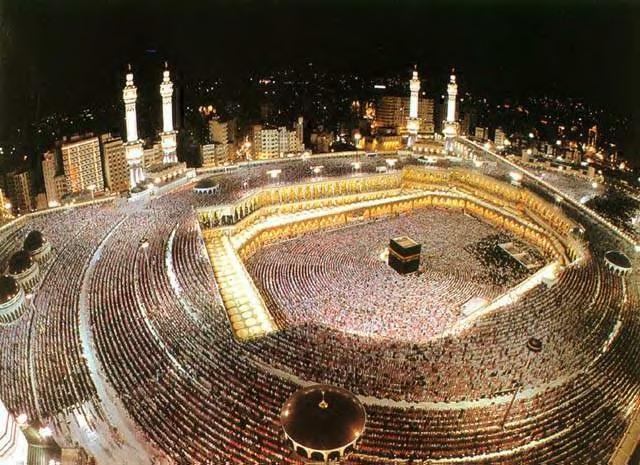
"Let us visit the historical cube in Mecca to conduct a thought-experiment: Imagine you are suspended in space in a satellite directly above the cube in Mecca. Presume also that it is night and all the lights in the world have been switched off. Now switch on the lights that shine on the courtyard of the Great Mosque of Mecca in which the cube is located and also switch on the lights of all the mosques of the world.
This is what you will see: directly below you will be the black square of the Kaaba at the centre of a vast concentric system of white circles that emanate from it like ripples. The innermost circles are in constant motion around it, and they are packed close together. White wheels within wheels unceasing in their motion. They are encircled by white circles that have a space between each other. These do not move around the cube but they do sway towards and away from it. Radiating away are unmoving white dots that make up bigger and bigger circles at greater distances from each other.
What are these three sets of ripples that emanate from the cube and what have they got to do with God asking Abraham to repair the cube?
The three sets of circles we saw while being suspended in space above the Kaaba were gatherings of people in different acts of worship (the word "ecclesiastical" which means "of the church" is from the Greek word ekklesia which means an assembly or gathering of people). Closest to the cube, the Kaaba, are the pilgrims dressed in the stipulated white unstitched garments, akin to their shrouds, circumambulating; walking seven times around the cube chanting to God, "Labaik, allahumma labaik" -"I am here, for You, I am here". They form the first set of moving concentric circles.
The next set of circles are pilgrims in concentric rows: standing, bowing and prostrating to God in the prescribed prayer. If the first set of circles move along the circumference then this set of circle moves along the radius, where each worshipper, while going from the standing, bowing and prostrating mode, is moving radially towards the centre of the cube and then receding. From your vantage viewpoint up in the night sky, this second set of circles would appear as white rings that pulsate: expanding in width and contracting. Finally, you have the distant circles that are made up of white dots that are the mosques of the world: segments of great circles (were you to light up all the graves of Muslims in the world, they too would lie in concentric ripples emanating from the Kaaba).
Thus, the mosque is defined as a segment of a circle whose centre is the Kaaba. For instance a mosque in New York would be a segment of the circle that passes through Canada, and crosses the Arctic to Russia, Mongolia, China, Vietnam, Singapore, and then crosses Antarctica, Peru, Colombia and Cuba, before re-entering the United States. The circle is made up by connecting the mosques, the white dots you saw from outer space that make the circle whose centre is the cube in Mecca.
This global concentric system made up by all the mosques in the world oriented to a single centre is a geometrical analogue of Tawhid - a doctrine of the Oneness of God and the unity of all existence. Tawhid is the foundation of Islam. Hence the cube is an ordering device; it is a marker that locates the centre of the concentric system. In it, all the axes of our horizontal plane of material existence converge and connect to the vertical axis mundi.
It is as an ordering device that the second, and less known, meaning of the word Kaaba comes into play. Kaaba, in Arabic, means the "cube" and also "a shape that emerges", i.e. both the form and the emergence of form. If the form is the cube, then what form remains to emerge?
As an ordering device, the Kaaba is not the modest cube in Mecca but a monumental project that has, for over a millennium now, been redefining the world in its own image. It has been constructing its circumferences (without which the centre is a point without identity). Each time a group of Muslims gather in prayer or build a mosque, each time Muslims follow the Prophet's practice of sleeping on the right side with their faces towards the Kaaba, each time a Muslim dies and is buried in a grave that is always oriented towards the Kaaba, in each instance a fragment of a circumference is being put into place. Prayer-halls, beds and graves are all rectangles with their larger side facing the Kaaba; all chords of its circumnavigating circles. With the global consolidation of a sacred centre, the faithful barely perceive that with their bricks and their bodies, they construct and constitute an international installation, the mother of all Monumental Art."
H. Masud Taj
12/10/2005
The Realty of Fantasy and the Fantasy of Realty
A sage lived to be couple of hundred years old. Yet, he never bothered to build a roof over his head. One day, his people asked him, how come he never built a roof for his house? He replied: “Well, I knew I was going to live for only 900 years (on earth), so why bother?”
(Can’t recall where I heard this)
12/06/2005
Sakeenah
I feel like a kid in a candy store...
Men and Women in Islam, For the Love of Our Children, Internal Nature of Shari'ah and its Eternality, Islam, Gender,and Spirituality... and so much more, now available on Sakeenah
Inaugral Welcome Message
12/05/2005
Overview of Muslims in America/American Islam
Covering Islam and Muslims in America Video - Professor Abdul HAkim Jackson
Linked From:
Agnibeena
Professor Sherman Jackson
Also, enjoy first 57 pages of Islam and the Blackamerican
12/02/2005
She Is a Ray of The Beauty of God

Water overpowers fire by (its) terror,
(yet) it boils when it is inside a partition.
(For) when a pot becomes the screen between
(these) two, it makes the water vanish (and) turns it (into) air.
If you dominate women outwardly, like water (over fire), you are
dominated inwardly and you are seeking [and boiling in desire for]
women.
This is such a special quality in mankind, (since) love is lacking
in animals, which is due to (their) deficiency.
The Prophet said, "Women become very dominant over wise and
pious (men),
"Yet ignorant (men) become dominant over women"-- because
they go (about) in a rash and very hot-tempered (manner).
They are lacking tenderness, kindness, and love because
animality dominates over (their) nature.
Love and tenderness are qualities of humanity, (while) anger and
lust are qualities of animality.
She is a ray of [the Beauty of] God; she is not a beloved.
She is a creator; you may say that she is not created.
Mathnawi I: 2429-37
12/01/2005
Is it worth it...?
I used to be angry. I was angry about all sorts of injustice in the world, mean people, unfair treatment, Dumb Principals -- Bush! i was so angry that i hardly did anything productive. i was so focused on the negatives in my life, that as a result, refused to do anything meaningful or positive. and then, I was given two excellent pieces of advice:
1. Our circumstances will never be perfect. An effective teacher/person is one who makes the best of her circumstances.
2. You’ve got to take that rage, that anger, and turn it into something positive.
and now i feel calm, unless im constipated, then ofcourse...ok nevermind. here's something interesting:
============================================================
"One thing most communities have in common now is that the people are in a state of agitation. One of the things that attracted me was the genuine sense of tranquility, calmness, and serenity in the masjids. People are starting to lose the virute of rida – tranquil serene acceptance of Allahs will. It’s alarming that Muslims should feel so disturbed or agitated by today’s world.
We complain about negative stereotypes but that’s always been the attitude toward the believers by the non-comprehending world. True religion is about akhira, it’s about transcending the self; it’s not about gratifying or discovering the self. We should be proud the modern world doesn’t like us because it’s a sign of authenticity. Nonetheless, it’s also the case when Muslims when they view this hostility don’t find solace in the traditional virtue of rida. We find agitation and insecurity and we increasingly judge, because any the slightest difference between ourselves makes us feel insecure, we want the religion to be a monolithic consistency that gratifies our sense of insecurity."
Excerpt from: Reliance on Allah
Prof. Hakim Murad
11/29/2005
Crazy - Talk
Sometimes I feel like a hero(ine). Not because I’ve done anything heroic but because I’m the central character of THE MOVIE. I’m a non- earthly spirit, an alien, (legal ofcourse), that’s been sent down to this world to fight many fights, to fall in love, to win many wars-- to deal with my subjects justly and fairly. I deal with all sorts of fellow spirits but mostly Zombies. Sometimes I’m a zombie myself but then I wake up during sleep. While sleeping, my sprit leaves this earthly body and goes on great adventures I don’t remember the next day. Maybe because my vertical connection is weak, I remind myself occasionally I need to take care of my connection, but five times a day seems like eternity sometimes.
Just like a car without an oil change my ‘self’ is covered with rust. Performance isn’t up to standard. That’s where Lord Shaitanmort comes into play. He distracts me with ME. He’s the salt-water that makes my ‘self’ rust even faster. But he’s just an extra. I’m the real deal – the real McCoy! Only I hold the power to be the ultimate Hero(ine) or Villain.
Occasionally, though, I do report back to the Compassionate Source and occasionally I do talk to the Beings of Light that stand by me, even though I suck. Why yes, I’ve got Beings of Light protecting me, watching over me, whispering to me. Unlike Beings of Flesh they constantly pray for me, weird aint it? Actually, whats weird is that im in a middle of a science fiction movie and I have a go at the 'Oscar' but instead I choose to be a D list actress. Actually, it’s sad, especially since my mama always said I was a drama-queen.
11/27/2005
Ali ra...
"The sin which makes you sad and repentant is more liked by Allah (swt) than the good deed which turns you arrogant."
11/25/2005
Pedagogy of the Oppressed

“Like Paulo, become a threat, become a threat to the system!” exclaimed a very excited NYU Professor couple of years ago. (No, he wasn’t talking to Muslims; he was simply addressing a group of student-teachers).
Imagine the teaching power of a person who is banned and exiled from a country for teaching. Yup, that’s it. And no he wasn’t teaching his students how to make bombs, either. He was simply banned for his Educational Philosophies. Now that’s power.
Paulo Friere, was banned from Brazil and lived in exile for most of his life. One wonders, why and how he was able to cause so much fear among authoritarian governments?
“In Brazil, peasants who participated in the cultural circles not only acquired tools to unveil structures of domination, but also acquired literacy skills in a record time of 40 days. Thus, the reason that led to the cancellation of the literacy project and to Freire's imprisonment was clearly not its inefficiency, but the military government's fear of its potential political implications. Upon being expelled from Brazil, Freire found political asylum in Bolivia, but after three weeks another coup d'etat forced him to seek refuge in an effervescent Chile, where a few years later he would witness yet another military intervention and a new exile. These experiences played an important role in his political radicalization.”
==============================================================
Excerpts taken from different sources but mostly from here:
1. In 'Pedagogy of the Oppressed,' Freire examines the authoritarian educational system, and labels its practice as 'banking education.' In this model, the teacher is the subject of the learning process, and the learners are its objects; the role of the teacher is to deposit contents in the mind of the learner, as if it was a tabula rasa to be filled with information. Hence, the teacher is considered as knowledgeable and the student as ignorant. This oppressive model, says Freire, mirrors the attitudes and practices of an oppressive society in which to be is merely to have. He also deplores the dogmatic approach of authoritarian revolutionary leaders who do not want to waste time in dialogue, thinking that such time could be better used to 'reveal the truth.' For Freire, this 'vanguardist' approach is as banking and reprehensible as the education model carried out by the elites.
2. Education either functions as an instrument which is used to facilitate integration of the younger generation into the logic of the present system and bring about conformity or it becomes the practice of freedom, the means by which men and women deal critically and creatively with reality and discover how to participate in the transformation of their world.
3. Paulo Freire recognized through this experience that learning which affirms the dignity of people can enable even poor men and women to become producers of culture, ready to overcome the culture of silence. The central objective of this method was to create a new level of awareness, to bring about a new consciousness among the people.
4. In opposition to the banking model, Freire proposes a liberatory or emancipatory one, based on a horizontal relation between teachers and learners (co-intentionality), on critical thinking and on social transformation. In Freire's model, the teacher becomes a facilitator, the traditional class becomes a cultural circle, the emphasis shifts form lecture to problem-posing strategies, and the content, previously removed from the learners' experience, becomes relevant to the group. For Freire, literacy implies as much the acquisition of language as a political process of citizenship, in which people take history into their hands. Hence, the departure point of any educational process is not the world of the teacher, but the world of the learner. He also suggested that a critical analysis of reality could start with a critical reading of the official curriculum. He pointed out that teachers and students alike tend to consider the curriculum as something given, a neutral content to be transmitted, without understanding that education is a political act. The more teachers and students challenge this naive perspective, the easier it becomes to engage in a critical analysis of social reality.
[to be cont'...]
11/18/2005
On Muslim Schools...

I’m surprised by the papers and articles I’ve browsed in the past few hours on Islamic Schools/Education in North America. Most authors believe that sending your child to a building labeled “Islamic School” will somehow transform him into the ideal muslim/muslimah, while sending your child to a public school will transform him into the illegitimate child of Britney Spears. Gulp?
Perhaps, I wouldn’t have ‘gulped’ if the following view was that of an uncle mullah or an auntie from back home but these views were of converts – Americans who’ve converted to Islam.
I went to a public school yet never tried drugs, wore small skirts, or had a bevy of boyfriends. I knew it was not part of the package to date before marriage even before I graduated kindergarten thanks to a very concerned mother. I don’t know why I didn’t try drugs, maybe because most students in my school weren’t selling drugs, or maybe because I was afraid my mother would whoop my arse (yes, we’re immigrants).
I’ve attended secular institutions all my life yet have always held a firm belief in God.
My learning of Islam began informally at an early age, at home. I grew up watching parents/grandparents reading salah, fasting, celebrating Ramadan and Eid. I learned maths and science in the morning and learned to read the quran in the afternoons. Solving mathematical problems or learning the Arabic language didn’t change my personality. Rather the change was the result of personal observation of models/stimuli around me.
I learned respecting elders was a virtue not from reading the Quran in Arabic but watching the way my mother treated her elders. I learned to love my elders not by reading salah in Arabic but by watching the lips of my grandfather which constantly moved sending durood on the Prophet (peace be upon him). My cousins and I used to try to outdo each other to bring water to one of my grandmothers sisters because she gave the best duas. Sometimes she would have to drink 5 glasses of water because we all wanted bonus points with Allah.
Having worked with two different Muslim Schools, I find it weird that the setting was only concerned with content but not how we learn to learn. Adding a Quranic Language and Islamic history course to a secular curriculum is somehow magically supposed to create an ideal muslim/muslimah? In most Muslim countries the practice of Islam is taught informally, outside of regular schools, not through formal settings like Islamic Schools or Sunday schools.
Learning is not something that takes place only in a classroom setting. In actuality, most of the learning takes place outside of the “classroom.” Even within the constructs of the classroom students not just observe the content but how the content is presented.
One could argue that learning how to learn is more important than the content itself.
Take Student X, a very bright child, placed in Hifz School XYZ at an early age. He can’t help peeking out of the door when ‘regular’ school-age students pass by during lunch break. He tells me he got hit by a hanger for doing it and is trying to learn his lesson so he can have his gaming rights back again from his parents. I wonder how much he’d love his religion when he grows up? (caution: example should not to be used to form ignorant generalizations about muslim schools in general.)
Meanwhile, theres student Y, an equally bright child, who is encouraged from an early age to question and explore, whose teachers treats him with unconditional respect, and whose parents lead a life that serves as a semi-good example for him. I wonder how different his perspective on life would be compared to student X?
I’m sure as new converts/reverts, lacking the moral support that comes with a practicing Muslim family unit, we strive to the best of our intentions and abilities to create an environment whose aim is to foster good moral values (Islamic values) and a desirability for God. But the creation of such environment isn’t found within cement or a concrete block with Arabic calligraphy; it is a process which begins with the birth of your child and ends with your last breath. If the child has the right support and role models from an early age, even a public/secular institution won’t lure him into sex and drugs. Similarly, abandoning your child to a poorly run Islamic school or once a week Sunday school won’t turn him into a Muslim scholar.
In conclusion, im not advocating one mode of schooling over another (heck, im thinking of home schooling, and I don’t even have kids, hah!), im just saying there are better arguments for creating Muslim schools than suggesting your kids will turn into cross-eyed-drugged out- sex offenders if you sent them to a public school. Really.
11/16/2005
Excerpts from Gifts From The Sea

"...I want first of all – in fact, as an end to these other desires – to be at peace with myself. I want a singleness of eye, a purity of intention, a central core to my life that will enable me to carry out these obligations and activities as well as I can. I want, in fact – to borrow from the languages of the saints – to live "in grace" as much of the time as possible."
===============================
“... Because we cannot deal with the many as individuals, we sometimes try to simplify the many into an abstraction called the mass. Because we cannot deal with the complexity of the present, we often over-ride it and live in a simplified dream of the future. Because we cannot solve our own problems right here at home, we talk about problems out there in the world...
But can one really feel deeply for an abstraction called the mass? Can one make the future a substitute for the present? And what guarantee have we that the future will be any better if we neglect the present? Can one solve world problems when one is unable to solve one’s own? Where have we arrived in this process? Have we been successful, working at the periphery of the circle and not at the center?
If we stop to think about it, are not the real casualties in modern life just these centers I have been discussing; the here, the now, the individual and his[/her] relationships? The present is passed over in the race for the future; the here is neglected in favor of the there; and the individual is dwarfed by the enormity of the mass...”
====================================================
"Life is a gift, given in trust - like a child."
=====================================================
"The most exhausting thing in life is being insincere."
=====================================================
Anne Morrow Lindbergh